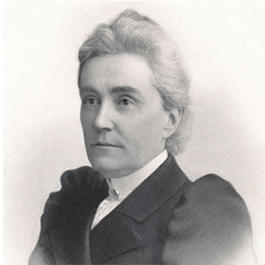
Fearless Females: Dr. Mary Edwards Walker

Dr. Walker wearing her medal.

In 245 years of American History, only one woman has ever received the Congressional Medal of Honor, the government’s highest and most prestigious military honor, and she did it back on Nov. 11, 1865. Meet woman of many trades – doctor, spy, abolitionist, P.O.W. – Dr. Mary Edwards Walker.

Mary Edwards was born Nov. 26, 1832, in Oswego, New York, to abolitionists Alvah and Vesta Whitcomb Walker. From a young age, they encouraged Mary to think for herself and allowed her to ditch the corsets and skirts expected of women in favor of “bloomers” (a dress combined with short pants), which would later lead her into the dress reform movement, which advocated for more reasonable and comfortable clothes for women.

Her parents believed that both boys and girls should be educated equally, so they started the first free school in Oswego, New York, to ensure their five daughters would learn the same things as their son. After that, Mary and two of her older sisters went to Falley Seminary in Fulton, New York. Mary never did stop wearing men’s clothes, as she felt they were more comfortable and hygienic.

Although Mary studied teaching, her real ambition was to become a doctor, something few women at the time dared contemplate, much less attempt. For her, teaching was a way to earn money for medical school. She attended Syracuse Medical College and received her medical degree in 1855—she was the second woman to graduate from the college, after Elizabeth Blackwell, whom we profiled in February.

Not long after graduation, Mary married fellow medical school student Albert Miller in a ceremony just as unconventional as fellow suffragist Lucy Stone’s. She refused to include “obey” in her wedding vows, kept her maiden name, and wore a short skirt and trousers instead of a traditional wedding dress. Husband and wife started their own medical practice in Rome, New York. Unfortunately, it was a complete failure because people did not trust a female doctor. The couple later divorced.

Her gender worked against her during the Civil War as well, when she was denied a post as a medical officer because she was a woman. Undeterred, Mary decided to volunteer as a surgeon at the U.S. Patent Office Hospital in Washington, but she was only allowed to be a nurse, not a surgeon. During her time there, she wore only trousers and shirts because they made her work easier. She also organized the Women’s Relief Organization to help families of the wounded.

In 1862, Mary moved to Virginia and started treating wounded soldiers near the front lines. She also wrote to the War Department in September of that year requesting to become a spy, but she was rejected. However, in 1863 her request to practice as a surgeon was finally accepted. She became the first female U.S. Army surgeon as a “Contract Acting Assistant Surgeon (civilian)” in Ohio.

Because she cared for all, Mary often crossed over Union and Confederate lines. In an ironic twist of fate, she was arrested in April 1864 by Confederate soldiers as a spy, the very occupation denied to her by the government. For the next four months, she was held as a prisoner of war in the notoriously brutal Castle Thunder outside of Richmond, Virginia, all the while refusing to wear the dresses provided to her. Later, when she was arrested in New Orleans for being dressed like a man, she famously said, “I don’t wear men’s clothes, I wear my own clothes.” She was eventually released as part of a prisoner exchange.

After the Civil War, Mary was awarded the Presidential Medal of Honor for Meritorious Service by President Andrew Johnson for her time as a P.O.W, the result of which was partial muscular atrophy that qualified her for disability. She became a suffragist and even attempted to register to vote in 1871 under the popular suffragist philosophy that the Fourteenth Amendment gave women the right to vote but was turned away. Inspired by other women in politics like Victoria Woodhull, Elizabeth Cady Stanton and Belva Lockwood, she ran for the U.S. Senate in 1881 and for Congress in 1890, both of which she lost.

In 1916, Mary’s Medal of Honor was revoked after the government decided she wasn’t really eligible, but she continued to wear it until her death in 1919 at the age of 86. She was buried wearing a black suit, still refusing in death to wear a dress. In 1977, President Jimmy Carter legally restored Mary’s Medal of Honor.

Mary told the world what she wished to be remembered for in 1897: “I am the original new woman…Before Lucy Stone, Mrs. [Amelia] Bloomer, Elizabeth Cady Stanton and Susan B. Anthony were, I am. In the early ’40’s, when they began their work in dress reform, I was already wearing pants…I have made it possible for the bicycle girl to wear the abbreviated skirt, and I have prepared the way for the girl in knickerbockers.”

Fierce Females: Annie G. Fox

Although American women couldn’t join the military on a permanent basis until 1948, they had been enlisting since Loretta Walsh became the first woman allowed to serve in any branch of the military in 1917. This month, we’re introducing you to Annie G. Fox, an Army nurse who was the first woman to receive the Purple Heart.

Annie Gayton Fox was born on Aug. 4, 1893, in East Pubnico, Nova Scotia, in Canada to Annie and Charles Fox, a doctor. Nothing is known of her life before 1918, when she enlisted to serve in the Army Nurse Corps in World War I or why she chose to do so. After her tour ended on July 14, 1920, she was based in New York, then Fort Sam Houston in Texas, and Fort Mason in San Diego. Annie was then transferred to the Philippines where she served at Camp John Hay in Benguet and then in Manilla.

In 1940, she returned to the United States, where she was stationed in Honolulu, Hawaii. There, she passed her exam to become Chief Nurse, was promoted to 1st Lieutenant and was transferred to Hickam Air Field Station Hospital, a small 30-bed hospital with six nurses.

Less than a month later, the Japanese attacked Pearl Harbor. Victims were sent to hospitals all over the island, including Hickam, where Annie was in charge. The noise of torpedoes, bombs, machine guns, and anti-aircraft guns was deafening and bombs fell all around the hospital, one leaving a 30-foot crater 20 feet from the hospital and another exploded across the street. Hospital staff, wearing gas masks and helmets, reported trying to save the wounded while enemy aircraft flew so close overhead that they could see the pilots conversing.

Annie not only cared for the wounded and assisted in surgery during the attack, but also organized civilian volunteers to provide assistance and make bandages. For her “outstanding performance of duty and meritorious acts of extraordinary fidelity” during this ordeal she was awarded the Purple Heart on Oct. 26, 1942, becoming the first woman to receive it. (At this time, recipients were not required to have been seriously wounded to receive this honor.)

The citation describes what Annie experienced and how she reacted:

“During the attack, Lieutenant Fox, in an exemplary manner, performed her duties as head Nurse of the Station Hospital… in addition she administered anesthesia to patients during the heaviest part of the bombardment, assisted in dressing the wounded, taught civilian volunteer nurses to make dressings, and worked ceaselessly with coolness and efficiency, and her fine example of calmness, courage and leadership was of great benefit to the morale of all with whom she came in contact….”

Two years later, the military added the stipulation that recipients of the Purple Heart had to sustain wounds during enemy action. As a result, on Oct. 6, 1944, Annie, now a Captain, was given a Bronze Star in lieu of her Purple Heart. The Bronze Star Medal is “awarded to members of the United States Armed Forces for either heroic achievement, heroic service, meritorious achievement, or meritorious service in a combat zone.”

After the war, Annie continued her military career in San Francisco, and then as Assistant to the Principal Chief Nurse at Camp Phillips, Kansas, where she was promoted to Major. She retired from active duty on Dec. 15, 1945, two years before President Harry S. Truman signed the Women’s Armed Services Integration Act into law, allowing women to serve as full members of all branches of the Armed Forces.

Annie eventually moved to San Diego to be with two of her sisters. She never married.  She died January 20, 1987, in San Francisco, at the age of 93.

In March 2017, Hawaii Magazine ranked her among a list of the most influential women in Hawaiian history.

Fearless Females: Sarah Hackett Stevenson

September is the American Medical Association’s (AMA) Women in Medicine Month, which celebrates the accomplishments of, and showcases advocacy for, female physicians, while also highlighting health issues impacting female patients.

Did you know that the AMA, which was founded in 1874, didn’t have its first female president until 1998? It didn’t even have any female leaders until 1969, when Louise C. Gloeckner became vice president. That’s nearly 100 years after today’s subject, Sarah Hackett Stevenson, became the first woman to join the AMA.

Early Life
Sarah was born in the small town of Buffalo Grove, (now Polo), in northwestern Illinois, which her father helped found. As a young woman, she attended Mount Carroll Seminary and State Normal College, in Bloomington, Illinois, and graduated with honors as a teacher. After several years of teaching and serving as a principal in public schools in Bloomington, Mount Morris and Sterling, Illinois, she moved to Chicago to study anatomy and physiology at Woman’s Hospital Medical College as one of its earliest students.

During her course of study, Sarah spent a year in England at South Kensington Science School in London learning from famed biologists Charles Darwin and Thomas Huxley. After returning to America, she graduated from the medical college with the highest honors in 1874, becoming one of Illinois’ first female physicians. She went back to Europe to continue her studies under Huxley and Darwin at hospitals in London and Dublin. During this time, she was appointed by Illinois Governor John Beveridg as a delegate to the International Sanitary Conference in Vienna, which was the fourth of 14 conferences organized to standardize international quarantine regulations against the spread of cholera, plague and yellow fever.

Medical Career
Back once again in the United States, Sarah began her medical career as physiology chair at the Woman’s Hospital Medical College in Chicago, a role she held for five years. In 1875 she was elected as a member of the Illinois State Medical Society and appointed head of the Illinois State Medical Society’s committee on progress in physiology. The following year, she was named an alternate delegate to the AMA convention in Philadelphia, becoming a full delegate and the organization’s first female member when the original male delegate was unable to attend. She appears to have met with surprisingly little resistance and even boldly listed her full name on the official delegate roster instead of using first and middle initials like many of her male colleagues.

She served as a delegate again three more times and in 1878, was chair of an AMA special committee for advancing physical sciences. In 1879, she presented a paper on the sympathetic nervous system. Sarah was also the first woman appointed on the State Board of Health and the first woman to be on staff at the Cook County Hospital. She wrote several books, including the well-known The Physiology of Woman.

Sometime in 1880, Sarah resigned from her position at Woman’s Medical College because she believed that men and women should be taught together, rather than segregated by gender. She wrote, “I hope that men and women will be educated in one institution–educated as physicians without any regard to the sex question at all. It seems to me, if we be physicians, that the first necessity is equality of opportunity, and that is all the woman physician asks.”

Advocacy for Women
Sarah was also actively involved in the temperance movement, serving as the first superintendent of the Department of Hygiene of the Woman’s Christian Temperance Union (WCTU) from 1881-1882. In 1886, the Chicago WCTU organized the National Temperance Hospital (later renamed the Frances Willard Hospital) with the express purpose of providing care without using medicines containing alcohol, and Sarah served as staff president.

Sarah was also a passionate advocate for women’s rights. Her writings on the plight of women in late 19th century Chicago are available online. But she didn’t only write about injustice; she acted to end it. In 1880 she co-founded the Illinois Training School for Nurses, along with Lucy Flower. In 1893, Sarah proposed to the Chicago Woman’s Club to create a safe home for women and children who did not have money but needed shelter. Her proposal was accepted and funded by donations as the Woman’s Model Lodging House. Those who could pay were charged 15 cents/night, but women who could not worked instead. She also spoke in support of admission of a black member to the Chicago Woman’s Club, of which she was president.

Sarah retired in 1903 after suffering a cerebral hemorrhage that left her paralyzed and bedridden. She died in 1909 at the age of 68.

New Facebook and Instagram Accounts

You may remember that a little over a month ago, my Facebook and Instagram accounts were suspended for no reason that I can guess. It could have been that someone reported me, that something I posted tripped a bot/algorithm or they found out I write under a pen name, which is against their TOS for a profile (but not a page, a famous person or a drag queen, go figure).

Anywho, today they disabled them completely, so I started new profiles and pages: Facebook and Instagram. It’s going to take me a while to catch up on all the news that happened while I was away. So please be patient as I rebuild.

While it sucks to lose all my friends and followers, if they are true friends or fans, they will find me again. I am choosing to look at this as an opportunity to start over and have more control over who I friend and what I see. I was in way too many groups anyway. 😉

What I Have Learned from This Experience

  • Build your email list as much as you can. Social media can be taken away from you at any time. (Have you signed up for my newsletter? If not, please do so now in case this happens again–I don’t want to lose you twice! It just might.)
  • Tighten your security as much as possible. FB lets you designate three to five people who can help you recover your account if something happens and I’m sure there are other ways of locking it down. You bet I will investigate every one of them.
  • If you have a page, set someone you trust as an administrator. Any way you can have other people will access to your account (within reason, of course) will help you if you ever get in trouble with our social media overlords.
  • Don’t accept friend requests from people you can’t trust. I don’t want to believe it, but it could have been a friend, family member or fellow author who reported me. So I’m going to be extra careful who I friend. There’s no guarantee it won’t happen with the new accounts. If we know each other well, you are welcome on my profile. If not, everyone is welcome on my page!
  • Be careful what you post. I’m not saying to not have opinions or censor yourself- I certainly won’t because it isn’t who I am. But just to give one example of the world we live in, apparently you can’t use the word “suicide” on any social media anymore. I had the word in a poem. That could be what got flagged. I don’t know how one is supposed to keep up with banned terms, but they do exist.
  • Think twice if you write under a pen name. FB allows drag queens and famous actors/authors to use pen names, but not the rest of us. Just go in knowing this may happen to you. One of my fairly famous author friends has been banned from FB four times for that exact reason. She just keeps coming back.
  • These companies don’t respond to their users. I spent a month and at least a dozen email and form exchanges with them to no avail. I provided multiple forms of ID and proof that [insert legal name here] really is Nicole Evelina. I sent them a “proof of life” photo with things they requested visible on a piece of paper. Yet this morning FB was still claiming I never protested my suspension. FB has no real person you can call and most of FB/Insta’s emails are no reply. Even if you do get an email that looks like it is from a real person and reply back, you won’t hear anything. Plus, the emails you do get will contradict each other. Or at least that was my experience.

So, anyway, here we are. I hope you will follow me on my new accounts. And have you signed up for my newsletter yet?

Just to be clear – I am only calling out drag queens in this post because they are a rare (and hard-fought) exception to the rules. I really like drag as an art form and would never want to disrespect anyone.

Another Book Contract!

After a lot of waiting and years of research, I’m so happy to announce this contract:

I am so thrilled to be sharing her “forgotten” story with the world. The biography is really a dual biography of her and her husband, Francis, because they were “partners in crime” on the subject of suffrage–and equal in all things (which was unusual for their time). However, there is far more information available on Virginia, but I was able to reconstruct a good portion of Francis’ career as a lawyer, as well as his suffrage work.

One of the reasons this book is so important to me is that the way we’re taught about the Suffrage Movement in school is that is was pretty much taken care of by Susan B. Anthony, Elizabeth Cady Stanton and a handful of other women. But that is far from the truth. The movement was actually progressed by thousands of women of all races and class levels. Writing them back into history is so important to a fuller understanding of the movement and its repercussions to us today.

America’s Forgotten Suffragists is a cradle to grave biography because it is the first one ever written about Virginia and Francis. Among the things you’ll learn about them:

  • Their early lives, education, courtship and wedding.
  • Virginia’s work during the Civil War in the health department and Francis’ work as a war claims agent.
  • Virginia’s founding of the Woman’s Suffrage Association of Missouri two years before Susan B. Anthony and Lucy Stone formed their national organizations.
  • How Virginia and Francis came up with the New Departure (the 14th amendment theory) and argued it through the court system all the way to the Supreme Court.
  • Virginia’s tax revolts (refusing to pay her taxes until women get the vote)
  • Her work with Susan B. Anthony to campaign for women’s suffrage in Nebraska
  • Virginia’s unorthodox funeral and will.
  • Posthumous honors for both

If you want a little preview of the biography, go to virginiaminor.com, a companion website I built for the book.

An Incredible Year
I’m going to take a minute to brag. This is my fourth book contract in six months (the one you may not know about is with our local chapter of the League of Women Voters for a book on 60 years of their history), along with a contract for a magazine article related to America’s Forgotten Suffragists.

HOWEVER, this explosion of luck is a long time coming. There is no such thing as overnight success, though it can appear that way. I have been writing seriously 13 years. In that time, I had one agent, got a lot of rejections, left her, self-published six books, got a book optioned for a movie/TV, got a wonderful new agent, Amy Collins, racked up more rejections and then finally everything hit. Hard work, never giving up (and believe me, it was tempting) and a great agent were for me the recipe for success.

I am firm believer that you have to work hard to achieve great things. That is what I have done from the beginning and that is what I will continue to do.

And for those of you who have noticed my contracts are all for non-fiction, don’t worry, I’m still writing fiction as well. I have four books I want to complete in 2022, in addition to my non-fiction on Fierce Females on Television. I may not finish all of them, but two are already started so it’s possible. I’m hoping to be able to slow down a little after next year, but this is what I mean about working hard to get my career jumpstarted.

Thank you all for your love and support!

Fearless Females: Mary Elizabeth (Eliza) Mahoney

August 1 was the anniversary of Mary Elizabeth (Eliza) Mahoney becoming the first Black woman to graduate from an American school of nursing. She’s considered the first officially trained Black nurse in the United States.

Early Life

Mary Eliza Mahoney was born in April or May of 1845 in Dorchester, Massachusetts, to parents who were freed slaves, originally from North Carolina. She attended the Phillips School, one of the first integrated schools in Boston (and the United States), for her early education, which is said to have influenced her later decision to become a nurse.

But in order to do that, she faced an uphill battle. Nursing schools in the South rejected applications from Black women and even in the North their opportunities were limited. For 15 years, the closest she could come was to work 16-hour days as a cook, maid and washerwoman at the New England Hospital for Women and Children in Boston – which was dedicated to providing health care only to women and their children and had an all-female staff of physicians.

Nursing Training

When the hospital (now the Dimock Community Health Center) opened a nursing program in 1878, Mary Eliza applied. Despite being two years older than the technical admission criteria, she was accepted at age 33 to a 16-month program, alongside 39 other students. Of this entire class, Mary Eliza and two white women were the only ones to receive their degree. (Mary Eliza’s sister, Ellen Mahoney, also decided to attend the same nursing program but was unsuccessful in receiving her diploma.)

It’s not hard to see why. The training was rigorous with the shift running from 5:30 a.m. – 9:30 p.m. for only meager wages. Students were required to spend time over the course of a year in all the hospital’s wards so that by the time they graduated, they understood each one intimately. Outside of lectures, they were taught bedside procedures such as taking vital signs and bandaging. The last two months of the program required the nurses to use their newfound knowledge and skills in environments they were not accustomed to such as hospitals or private family homes. Mary Eliza chose to work as a private-duty nurse.

On August 1, 1879, Mary Eliza became the first Black woman to graduate from an American school of nursing and is considered the first officially trained Black nurse in the United States.

Career

Mary Eliza worked for many years as a private care nurse, predominately in white households with new mothers and newborns. During the early years of her employment, Black nurses were often treated as if they were household servants rather than professionals. Nevertheless, families who employed her praised her efficiency in her nursing profession. Mary Eliza’s professionalism helped raise the status and standards of all nurses, especially minorities. As her reputation spread, she received private-duty nursing requests from patients in states in the North and on the southeast coast.

In 1908, Mary Eliza worked closely with Martha Minerva Franklin and Adah B. Thoms who founded the National Association of Colored Graduate Nurses (NACGN.] This organization attempted to uplift the standards and everyday lives of Black registered nurses and had a significant influence on eliminating racial discrimination in the profession until it was integrated into the American Nurses Association in 1951. From 1910 to 1930 alone, the number of Black nurses doubled, thanks to Mary Eliza’s efforts.

From 1911 to 1912, Mary Eliza served as director of the Howard Colored Orphan Asylum for Black children in Kings Park, Long Island, New York, a home for freed Black children and elderly. After one year on the job, she decided to retire.

Later Life

Her nursing career complete, Mary Eliza focused her attention on women’s suffrage. In 1920, after women won the vote, she was among the first women in Boston to register.

In 1923, Mary Eliza was diagnosed with breast cancer, a battle she fought for three years until her death at the age of 80 on January 4, 1926.

In recognition of her outstanding example to nurses of all races, the NACGN established the Mary Mahoney Award in 1936. It is still given out today by the American Nurses Association every two years in recognition of significant contributions in advancing equal opportunities in nursing for members of minority groups.

Mary Eliza received many posthumous honors and awards for her pioneering work. She was inducted into the American Nurses Association Hall of Fame in 1976 and into the National Women’s Hall of Fame in 1993. Her name also graces a health center in Oklahoma City, a dialysis center in Boston and a lecture series at Indiana University Northwest.

If you’d like to learn more about her, check out Susan Muaddi Darraj’s book Mary Eliza Mahoney and the Legacy of African-American Nurses.

Two-Book Traditional Publishing Deal!

So…I have news!

I am over-the-moon excited! I’m finally a hybrid author! This has been a long time coming and I am so excited to write these books. Here’s a little more about them:

Obviously, not the real cover.

Sex and the City: A Cultural History
This book will provide cultural context and analysis of the famous show, both how it affected cultural as it aired and also how it looks now 20+ years later. Some topics include:

  • Looking at what it means to relate to each of the girls (ala, Are you a Carrie? A Samantha? A Miranda? A Charlotte?)
  • What the men in the show illustrate about masculinity and what that means about the kinds of men women are attracted to.
  • Issues like diversity or lack thereof, treatment of sex and sexuality, LGBTQIA portrayal.
  • How the show made New York a character, built brands, influenced fashion and reflected third wave feminism.
  • And a lot more!

I have an end of year deadline, so hopefully the book will come out around the time the reboot, And Just Like That, airs.

Fierce Females in Television: A Cultural History

Thank God, not the real cover!

This book will briefly discuss the nature of physically strong women on TV from the 1950s-1980s, but will focus specifically on the 1990s to today because that is when we saw a major ramp up in the portrayal of these kinds of women.

Shows covered include: Xena: Warrior Princess (1995-2001), Buffy the Vampire Slayer (1997-2003), Charmed (1998-2006), Alias (2001-2006), Nikita (2010-2013), Agent Carter (2015-2016), Jessica Jones (2015-2019), Game of Thrones (2011-2019), and Homeland (2011-2020).

Some of the topics include:

  • An analysis of the main female characters on each show.
  • The meaning of female strength and friendships/family.
  • The influence of third- and fourth-wave feminism on the shows and their characters.
  • Treatment of sex and diversity.
  • The role of redemption narratives and change in female lives.
  • And more!

This book will be out sometime in 2023/24.

Between these, the League of Women Voters book (due Oct. 4) and at least one work of historical fiction, you know what my next few months and even my 2022 will look like!

Reading Tarot Spreads to Help With Your Writing

This is the second part in a series on the tarot. If you’re new to it, please start with part one for an introduction to the cards, how they work and what they mean, then come back to learn how to use them in your writing.

Before you read, you might like to find a quiet place where you can be alone with your thoughts and really think about what each card is trying tell you. Have a notebook and pen, or your computer handy so you can jot down ideas as they come to you. Some people choose to lay out a special cloth (usually a solid color) on which to place the cards because it helps focus the mind. If you are religious, you might want to ask your guardian angel or the muses or whatever god(s) you believe in to guide your reading, but that is totally optional.

To begin, take a deep breath and close your eyes. Think about your question. If you are using your reading to build out your plot from the beginning, you might ask a question like “What is the framework of this book?” or “Show me how this plot should progress.” If you’re trying the work through a block, think about it as specifically as you can, something like “what happens to X character next?” or “How does X get out of [name the jam you put them in].” If you are building a character you could start with “Show me X’s progression throughout the book.” Keep repeating your question in your mind over and over as you shuffle the deck. You’ll know when to stop. Sometimes you will feel a card get hot or cold or your fingers will tingle. Other times, you just know to stop. Sometimes nothing at all happens and you just get tired of shuffling. Trust your instincts; there are no wrong answer. Once you feel ready, draw your first card from the top of the deck.

Because of their unique symbolism, you can always do readings using only the major or minor arcana cards if you want to. But I have found that using both major and minor arcana (which is the standard practice) gives you a more complete picture. There are three basic types of spreads, which I’ll explain from the easiest to the most complex.

One Card Spreads

This involves drawing a single card and is the fastest and easiest, It allows you to be very focused in your question and answer, but it also provides you with the least amount of information because you don’t have the influence of surrounding cards. But if you are in a hurry or just need a prompt to get you going, one is all you need. Potential uses:

Getting to know your characters – Draw a card for each major character in your plot. This will tell you a lot about them, since we each have a card that best symbolizes who we are. (Mine is Strength.) This is best determined over time through multiple readings when the same card keeps showing up over and over again, but can also be done with a single reading.

I recently did this for a book I was plotting. It is biographical historical fiction set in WWII Poland and the card I drew was the Knight of Wands . This card symbolizes someone clever, with a strong sense of humor who is good with words and has sound instincts and a gift for seeing things others may have missed. This describes my heroine (who was a real person) to a tee. Because of this card, I learned what key aspects of her personality to focus on when writing.

Get to know the overall “vibe” of your book. A single card can also tell you about the theme(s) of your book. As I was writing this article, I pulled a card for my latest project, another biographical historical, this one set the colonial United States. My card was The Five of Wands I was immediately struck by the image, which shows five people fighting with staves, because while my book written in a single first-person POV, there are multiple competing timelines and storylines to keep straight, so much so that I needed to make a chart.

The meaning of the card is competition and being obsessed with material things or as the book that came with the deck puts it “keeping up with the Joneses.” That is certainly relevant because there are many men competing for the affection of my heroine. She also a very well-to-do woman who was known historically for her lavish parties and spending that, combined with her husband’s gambling, eventually drove them deep into debt. The card can also mean a clash of ideas and principles and hurting others by giving mixed messages. My main character is in love with her sisters’ husband and both are tempted to have an affair. Much of their relationship takes place via letter and because of both, they often wonder what the other really feels.

(While I was writing this, I accidently knocked the next card off the top of the deck. It was The Lovers which is what I was expecting the main card for the book to be because it is essentially a story of forbidden love. Always pay attention when cards fall out of the deck as you shuffle or otherwise make themselves known—it happens for a reason.

Find the answer to a plot problem or writer’s block. All you have to do here is ask what the problem is. Pay close attention to what the card symbolizes. It may tell you where you’ve gone wrong in plotting in another part of the book, directly answer your question, or even tell you about something in yourself that is causing the block (such as being overworked and needing to take a break).

Three Card Spreads

There are many variations on three-card spreads, but the most common is past-present-future, which can be used for both plots and characters.

  • If you write to a three-act structure, you could use this spread to learn about the themes of each act.
  • You could take each of your major characters and do a past-present-future spread to learn about their backstory, where they are when the book begins, and how they change as the novel progresses.
  • For character arcs, think about one card as being where the character is now, the second as where they want to be, and the third how to get there.
  • If you are experiencing a writing problem, you can have one card symbolize the nature of the problem, one the cause, and one the solution. Similarly, you can have the cards stand for what the character wants/what will help them, what is standing in their way, and how to overcome it.
  • We’ve all heard about MRUs (motivation reaction units), right? One card can be your character’s thought/feeling, one their reaction, and the third, what he or she is going to say or do in response.
  • If you are mulling over the relationship between characters you could have one card stand for each character and the third for their relationship. Or you could use one for what brought them together, one for what pulls them apart, and the third for the resolution. (This one is particularly good for romance novels and romantic plotlines.)

You could seriously go on forever with these. There’s a long list of three-card spreads online here.

The Celtic Cross Spread

This is the classic tarot spread, the one you’ve seen in every TV show and movie with a fortune teller and the one you will see if you go visit one in real life. This is because it is the most comprehensive. I’m going to explain it first, and then show you a few ways to use it.

The Celtic Cross spread involves 10 or 11 cards. Some people choose to designate one card that is set off to the side to symbolize the question or the person asking the question. If you choose to do this, you will draw that card first after you have finished shuffling the deck. Then draw the cards from the top of the deck and lay them out according to the pattern above.

Once you’ve done that. Take a look at the overall spread. Is your gut telling you anything? Does the spread feel inherently happy or sad, positive or negative? Does anything immediately jump out at you? It can take some time to develop the ability to get the “feel” for a spread, so don’t worry if you don’t come up with anything right away.

Next, take a look at each card individually. Write down your impressions of each one. I did a reading for my colonial American book while writing this using the question “show me what I need to know about X book” and I’ll give you my cards as well as an example.

My overall impression is that this is a positive reading with five major arcana cards (which is a lot) and no dominant suit (two swords and two pentacles, which neutralize each other’s negative and positive elements). It’s going to be an interesting reading.

  1. Relationship to the Present Situation. Queen of Swords – An impressive, trailblazing woman of courage and intelligence who will not be held down by convention. This is my main character very clearly summed up.
  2. Positive Forces in Your Favor. The Chariot – Triumph, balance, holding opposing views in equal tension. Enjoying life. This describes my character’s approach to life pretty well, though she’s more known for extravagance than balance.
  3. Message from Your Higher Self – Queen of Pentacles – Female strength and success in business and with money. A caring woman concerned with the lives of those around her. Again, you have to trust me that this fits my character very well.
  4. Subconscious/Underlying Themes/Emotional – The Priestess – Inspiration and advice from a woman who is wise and mature. Can also represent isolation. That last part is interesting to me because my heroine spends most of the book in another country than the rest of her family. Her best friend could easily be represented by the priestess and would provide calm to her boundless energy.
  5. The Past – The Fool – Setting off on a journey unaware of an uncaring of the consequences; innocence and foolishness. My character married very young and regrets it almost immediately when her husband turns out not to be who she though he was (quite literally) and she falls in love with someone else, but can’t have him because she is already married.
  6. Relationship with Others – The Two of Cups – The minor arcana card most like The Lovers. Represents relationships, attraction, engagement/marriage and emotional bonds. Perfect for describing the forbidden love she experiences for most of her life.
  7. Psychological States/Forces That Can Affect the Outcome – The Six of Swords. Ugh, the swords. Movement, alignment of heart and mind, a declaration of love, focus and follow-through with unpredictable results. Funny that this one depicts a journey across water because my character travels back and forth between America and Europe a lot. Again, I see shades of the forbidden romance in this card, especially since it comes right between the Two of Cups and The Sun
  8. Environment/Unseen Forces – The Sun – Triumph, bounty, enjoying life. It is interesting that the book that comes with this deck mentions “summer love” in connection to this card. If my two historical people ever actually consummated their affair, it would have been a particular summer while his wife was away.
  9. Hopes and Fears – The Magician – A man of creativity, power and strong voice who is eloquent and charming. This could be my hero and describe what my heroine sees in him. This card can also mean someone who is manipulative and at times untrue, which applies to her fears about him just being a flirt and not really loving her since she is already married. (Which is something historians haven’t even figured out.)
  10. Outcome – The King of Pentacles – A proud, self-assured young man of status and wealth, a supportive husband who recognizes the value of culture. This card could represent either her husband or her lover. Her husband is proud and wealthy, but he is not exactly supportive, while her lover is. I see this as the outcome she wants; her ideal man. Unfortunately, he does not exist and history does not bear out a happy ending for her or her lover. However, as a writer, I see this as an opportunity to really amp up the tragedy of the ending. Outcomes are even more powerful when the hero and heroine don’t get what they want because readers have been rooting for them the entire book and now will mourn with them as well.

Finally, look at the cards in groups of three or four. Do they affect each other or change the meaning of surrounding cards? Make notes of anything that notice. Again, it may take time to learn this part. In my example, as you can see from the explanations above, the first four cards agree with each other and strengthen one another in a description of my heroine. In the same way, cards six through nine all play on the same theme of forbidden love. Taken together, these influenced my interpretation of the Outcome card.

Of course, everything is subject to interpretation; I may read a spread totally differently than you do, which is why some people don’t put any stock in tarot readings. And that is fine. I’m only here to advise you on how you can use them as a tool in your writing; whether or not you believe they will work for you is a personal decision.

Once you get comfortable with your cards you can also make up your own spreads to fit your questions. They can be circular, triangle, any shape that works for what you need. You could even take the major archetypes and draw a card for each one or take your favorite plot arc or character arc tool (I’m a fan of Michael Hauge’s “Six Stage Plot Structure” and Larry Brooks’ Four Part Structure) and make up a spread to fit it. The sky is the limit.

I hope this series of articles has given you a new tool in your writing toolbox. If you are familiar with other systems of divination like runes, wisdom sticks, or even astrology or dowsing with a pendulum, you can employ those as well. They all tap into your subconscious mind in a similar manner. Best of luck!