Feminism: One Movement in Four Waves (Part 1)

Some of you may be aware that I’m working on a proposal for a non-fiction book on the history of U.S. feminism that I hope to have published on or near the 100th anniversary of American women getting the right to vote, which is August 19, 2020.  This week, Diana at Creating Herstory is featuring a four-part article I wrote on this very same subject and I thought I’d repost the article each day as it runs on her site. It will give you a rough idea of what the book will include, although the book also will have a section on colonial feminist thought that this article doesn’t cover.

Image purchased from Adobe Stock

For me, every day is Women’s History month because I’m currently researching the history of the feminism movement in the United States for a book.

Honestly, although I’ve considered myself a feminist for more than 20 years, I never really thought much about the movement in general or how it came to be. But then I researched my historical fiction novel Madame Presidentess, which is about Victoria Woodhull, a suffragist and the first woman to run for president in the U.S. in 1872 – 48 years before women won the right to vote. Because she was friends with the likes of Elizabeth Cady Stanton and Susan B. Anthony, I came to learn a lot about how feminism and women’s rights came to be in our country.

Historians generally agree that there have been at least three “waves” or intense periods of activity around women’s rights. But that is where the consensus ends. Exactly when these waves took place and what they encompassed is a serious matter of debate, especially where later waves are concerned. Some people (like me), believe we’re currently living in a fourth wave of feminism, while others say we’re still in the third or even in a fifth. There is even some debate on whether or not feminism in American dates back to colonial times, far before the generally accepted seminal event of the 1848 Seneca Falls Convention.

While one article could never do justice to the many facets of the feminist movement (that’s what the book is for, and even then it is impossible to hit all points), here’s a brief summary of the three accepted waves, as well as my theory of a current fourth wave. All dates are approximate.

Wave One: 1840-1920 – Women Fight for Citizenship and Suffrage
Key figures: Susan B. Anthony, Elizabeth Cady Stanton, Lucretia Mott, Lucy Stone, Alice Paul, Carrie Chapman Catt, and others.

Susan B. Anthony (standing) and Elizabeth Cady Stanton. Source: Wikimedia Commons

Beginning in the 1830s, women started to quietly talk amongst themselves about their rights and to question why, under United States law, they were not considered full citizens. This eventually led to the first public debate on women’s rights at Oberlin College in 1846 and the first public address about women’s rights the next year. The first women’s rights convention in the United States took place the following July in Seneca Falls, New York. From this meeting came the Declaration of Sentiments, which was modeled on the Declaration of Independence, was all about woman and her rights, or lack thereof, in the country at that time. It became the basis for the women’s rights movement until the Civil War disrupted the whole country and placed the public’s attention squarely on abolition.

After the Civil War, the women’s movement split into two groups divided over the idea of enfranchisement of blacks as well as whether universal suffrage should be granted at the Federal or state levels. Susan B. Anthony and Elizabeth Cady Stanton were the leaders of the radical National Woman Suffrage Association, whose members believed that the enfranchisement of black and immigrant men would make it more difficult for women to be given the vote and called for a federal agreement for women suffrage. On the other side of the fence were Lucy Stone and the American Woman Suffrage Association, whose members supported the 15th Amendment and worked for women’s suffrage on a state-by-state basis.

This division hampered the efforts of both groups, by weakening resources, causing in-fighting within the movement and fracturing public attention. As time went on, some states granted suffrage on a case-by-case basis, usually beginning with school suffrage. The first state to grant women full voting rights was Wyoming in 1869. In 1872, Victoria Woodhull ran for president, even though she wasn’t technically old enough and the vast majority of women didn’t have the right to vote for her. Despite the odds, Susan B. Anthony succeeded in voting in that election (not for Victoria, as the two were bitter enemies by this point) but was arrested and found guilty of illegal voting. But she made history and headlines with her act, and her widely publicized trial spurred on flagging suffragists across the country. In 1875, Virginia Minor, a suffragist from Missouri, argued before the Supreme Court that women already had the right to vote under the 14th amendment of the Constitution, which that states suffrage is a right of all citizens of the United States. But the Supreme Court ruled against her, stating that all “men” had the right to vote, and the suffragists realized that the Federal government wasn’t going to help them. Thus began the decades-long campaign

Women’s Rights National Historical Park. Image purchased from Adobe Stock.

for an amendment to the U.S. Constitution that would enfranchise women.

The two warring factions of women’s suffrage finally reunited in 1890 as the National American Woman Suffrage Association (NAWSA), under the united cause of getting suffrage state-by-state. Twenty-six years later, tired of this slow, tame approach, Alice Paul formed the National Woman’s Party, a militant group focused on the passage of a national suffrage amendment. The following year, more than 200 members of this group – known as the Silent Sentinels – were arrested while picketing the White House. Many of them went on hunger strikes in prison and were subjected to torture and barbaric practices like forced feeding. (These women were the Iron-Jawed Angels of the 2004 film of the same name.)

Despite these setbacks, the women’s movement continued under the leadership of Carrie Chapman Catt, who focused whole-heartedly on the national amendment from 1916 on. Women finally gained the right to vote on a Federal level on August 20, 1920. But it took a long time for the states to catch up (Mississippi was the last state in the union to ratify the Nineteenth Amendment in 1984) and it wasn’t for several decades that African-American women were truly able to vote without fear of discrimination and harm.

Tomorrow’s Part 2 will talk about the Second Wave of feminism, which lasted approximately from 1960-the late 1980s.

P.S. – Did you know that the National Woman’s Party still exists? I’m a member!

Interview with Bestselling Historical Novelist C.S. Harris

813djule6wlI am so excited to bring you today an interview I recently had with bestselling historical novelist C.S. Harris. You may know her from her wildly popular Sebastian St. Cyr thrillers, or maybe under her other names Candice Proctor or C.S. Graham.  Now she’s out with a new Civil War-era historical novel, Good Time Coming, which I was fortunate to be given a copy of through the Historical Novel Society. I’ll be writing a feature article on it that I’ll share once it’s published, but I was also lucky enough to get to sit down with C.S. and ask her a few questions. And I have to say, this is one of the best interviews I’ve ever had here.

Most people know you for your Sebastian St. Cyr mysteries. What made you want to change from writing Regency historical thrillers to straight historical fiction set during the Civil War?

I am still writing my Sebastian St. Cyr mystery series—the twelfth installment, WHERE THE DEAD LIE, will be out in April 2017, and I’ve almost finished #13, tentatively entitled WHY NOT THE INNOCENT. But it’s all too easy for an author to get into a rut writing the same kinds of stories with the same characters and settings. So I think it’s important for any writer—and especially one with a long-running series—to occasionally venture outside her safe zone and try something different. For a while I was also writing a contemporary thriller series, but I found keeping two series going at the same time too stressful. So a standalone seemed the best answer.

What was your inspiration to write Good Time Coming?

C.S. Harris

C.S. Harris

My very first historical mystery, Midnight Confessions, was set in Occupied New Orleans (the book has been revised for republication and should be available early next year). In the process of researching that story I became fascinated with the effects of the Civil War on the population of Louisiana (spoiler: it was pretty horrific), and I’d been wanting to write a straight historical about that ever since. What happened to civilians in the Civil War is a virtually untold story.


Why did you choose to make your protagonist a 12-year-old-girl?

Some of my favorite books have been coming of age tales, and it seemed the right way to tell this story. Children bring an unblinking honesty to their experiences that I felt was particularly appropriate for the complexity of the issues I wanted to explore. The journey from child to adult is basically a loss of innocence, and to watch that development happen to someone in the midst of an experience as horrendous as war is truly gripping.

And Amrie is a girl because we already have countless books about the experiences of boys and men in war. This is about war as seen through the eyes of the women and children left behind to cope with a world falling apart in every way imaginable.

What kind of research did you do to make the book historically accurate?

I researched this book for almost a dozen years. I read hundreds of letters, journals, and memories, along with general histories of the Civil War and more specific monographs. I visited the story’s various towns and battle sites—Port Hudson and Camp Moore, Bayou Sara and Jackson—and spent many a day wandering around St. Francisville’s haunting churchyard. I basically took the real incidents recorded by people who lived through the war and wove them into a story. With the exception of the central incident in the book—Amrie’s killing of the Federal captain and the events that flow from it—I made up very little of what’s in this story. And that is truly terrifying to think about.


How hard was it for you to work from the point of view of the South when traditionally history is told by the victors, and therefore our country has glorified the role of the North? How did this influence the way you told your story?

I had to make Amrie’s family staunch abolitionists; I simply could not have been sufficiently sympathetic to them as main characters otherwise. Plus I liked the way this shifted the dynamic of their interactions with their neighbors, both white and free people of color. But when it came to the actual events in the story, all I did was stay true to what actually happened to the women and children of St. Francisville. It really was brutal. As a professional historian, I’ve always been irritated by our cultural tendency to both glorify war and forgive the sins of one side while focusing endlessly on the sins of the other. This book doesn’t shy away from the sins committed by either side.

And I should probably state for the record that the only Civil War veterans on my personal family tree fought for the Union; one great-great uncle even died at Andersonville.

One of the things that struck me the most about this book was your willingness to challenge long-held beliefs and viewpoints about the Civil War (i.e. President Lincoln was a hero, he abolished slavery out of the goodness of his heart, the Northern soldiers were the good guys and the Southern the bad, etc.) Can you please tell me a little about your motivation behind this and what kind of a reaction you’ve received so far?

I think it probably comes down, again, to my training as a historian. I have long been bothered by the all too common tendency to turn history into a series of comfortable myths that we as a nation tell ourselves to make ourselves feel good about our past. It’s incredible to me that here we are 150 years later and both sides of that war are still telling themselves “feel good” distortions and outright lies. Lincoln’s Emancipation Proclamation was a wonderful thing, but that shouldn’t lead us to distort the explicit reasons he gave for doing it, or overlook the truly heinous things he also did. Likewise, too many Southerners still stubbornly refuse to acknowledge just how horrific the institution of slavery was both in theory and in practice. I don’t spare either side in this book. I guess in a lot of ways this story was an expression of my frustration with myth-making. I wanted to write about what really happened because it is so important to acknowledge that and finally have a real conversation about it. Unfortunately, myth busting is not popular!

In the Author’s Notes to the book you talk about a reticence of history to admit to rape being employed as a weapon of war during the Civil War. (I came up against a similar circumstance when depicting Guinevere’s rape by Malegant in Arthurian legend – most people either don’t know its part of the myth or don’t want to think about it.) Can you please talk a little about your reasons for including it and how you came to understand it would be important to your story?

When I first started plotting this book, I believed the commonly accepted “truth” that rape in the Civil War was rare. But as I read all those original sources written by the women who actually lived through it, I realized that was just one more myth.  Rape has always been a part of war. What we’ve seen in our own lifetimes in places like Bosnia and the Congo isn’t something new; it’s the reality of war, and it has always been. But historically, women who were raped in wartime did not talk about it. Why would they, given their societies’ traditional ostracization of women who were raped?

As I read these women’s accounts, I also came to realize the importance of the fact that the people of 1860 weren’t very far removed from the time of the American Revolution and the War of 1812. That meant they knew exactly what had happened to their mothers and grandmothers in those wars (something else we don’t talk about). It’s one of the reasons the people of the South were so afraid of those armies of men marching against them. And they were right to be afraid. The North’s battle cry was “Beauty and Bounty!” In other words, Rape and Plunder! Yet 150 years later we still don’t like to admit it.

To be honest, I didn’t realize just how controversial this aspect of my story would be. Many of the editors who read the manuscript cited the rape part as their main reason for rejecting it. I guess as a writer you can kill people by the thousands, but you’d better not have a woman raped by American soldiers.

What do you think are the key themes of this novel? What do you hope readers walk away from it knowing/believing/feeling?

This book is about women’s resilience in the face of crushing adversity, about the way friends and neighbors can come together to survive great hardships, about love and loss and, ultimately, the triumph of the human spirit.

But the main theme of this book is the idea that there is good and bad in every person and every nation. I am frankly shocked by some of the things I am seeing in our country today. I never thought I’d see Americans screaming “Sieg heil!” and panting swastikas on tombs, or hear talk of the Nazi-style registration and internment of a religious minority. Somehow we have failed to learn the right lessons from history, and I think the tendency to mythologize the past is one of the reasons for that failure.

If you could summarize your experience writing Good Time Coming in one sentence, what would it be?

Oh, wow; that’s hard! I’d say writing Good Time Coming forced me to move outside my comfort zone in many different ways; to confront my own prejudices and assumptions; and to think long and hard about what it would be like to experience things I hope I’ll never have to face.

Do you plan to write more straight historical fiction like Good Time Coming? What can readers expect from you next?

I do plan to continue writing other things as I also write my Sebastian St. Cyr series. I’ve just finished a novella set in World War II that will be part of an anthology due out probably in 2018. That was a new experience for me because I’d never written anything that short before. It’s a very different format, so that was a challenge.

Is there anything else you’d like to talk about that we haven’t touched upon?

I find it unfortunate that coming of age novels these days tend to be seen by the publishing industry as “young adult novels.” They don’t have to be, and in fact some of the best were never written to be. I also find it curious that editors think young adults can handle large-scale massacres, zombies, vampires, and the end of the world, but not non-graphic rape. What does that say about us?

Thank you, C.S. Harris for being with us today. Good Time Coming hits stores December 1, so you don’t have to wait long to read it for yourself. Pre-order or order it today! You won’t regret it; it really is a great book.

Questions for the author? Leave them here and I’ll let her know she can get back to you.

Victoria Woodull’s 1872 Election Day as Seen on Facebook

“Lock her up!” is a common refrain in this election, with opponents of Hillary Clinton, the first woman to run for president on a major party ticket, loudly calling for her to spend election day in jail. Ironic then, that the first woman to ever run for President in the U.S., Victoria Woodhull, did just that in 1872.

Days before the November 4, 1872, election, she and her sister, Tennie, published a scandalous issue of their newspaper, Woodhull & Claflin’s Weekly, in which Victoria accused Rev. Henry Ward Beecher of having an extramarital affair with one of his parishioners, and Tennie recalled the debauchery of a public party years before. Due to a quote Tennie used (which also appears in the book of Deuteronomy), the sisters were changed by Anthony Comstock, America’s self-appointed moral crusader, of sending obscene material through the mail and arrested.

I present to you my imaginings of what Victoria, Tennie and the other women of the suffrage movement might have posted on Facebook on and around Election Day.

victorias-election-day-as-played-out-on-fb

Imagining a Twitter War Between Victoria Woodhull and Catharine Beecher

In 2016 we’ve seen Twitter wars between the two major political candidates for president of the United States, one of whom is the first woman running for president on a major party ticket. But she’s not the first woman to ever run for president in the United States. That honor goes to Victoria Woodhull, who ran back in 1872, 48 years before women got the right to vote in the US.

Not long ago, I got bored and imagined what a similar Twitter war may have looked like if such technology existed in 1872. Though Victoria and Catharine Beecher fought over many topics, one of the most bitter recounted in contentious letters swapped between the two and in conversations recalled in biographies of Victoria, was about the Victoria’s espousal of Free Love – the idea that the government shouldn’t have the right to say when marriage begins or ends – and the hypocrisy Rev. Henry Ward Beecher in preaching against adultery while his mistresses sat in the pews.

Here’s how that early Twitter war may have played out, with a bit of a modern twist. (Many of the words in the last four tweets are from an actual fight between the two women.)

twitter-war

Voting Was Very Different in 1872

H. Balling, "Victoria C. Woodhull at the Polls," Harper's Weekly, 25 November 1871

H. Balling, “Victoria C. Woodhull at the Polls,” Harper’s Weekly, 25 November 1871

With less than two weeks until the 2016 election here in the United States, I thought it would be interesting to take a look at how the voting process has changed since Victoria Woodhull’s time. Today we go into a private, curtained booth or at least stand at shielded machines to cast our vote.  Unless we divulge it, there isn’t supposed to be any way for anyone else to know who we voted for.

In 1872, not so much.

When I went into my research for Madame Presidentess, I had no idea that votes weren’t always anonymous.  America began using the “Australian Ballot” for presidential elections in 1888. According to Encyclopedia Britannica, the Australian Ballot is defines as “the system of voting in which voters mark their choices in privacy on uniform ballots printed and distributed by the government or designate their choices by some other secret means.” 1888 is also the same year America used the first mass marketed automated polling system – the Myers Automatic Booth.

This ballot for the Equal Rights Party at the re-enactment of 1872 shows what the ballot for Victoria may have looked like. Note that no historical ballots for her exist.

This ballot for the Equal Rights Party at the re-enactment of 1872 shows what the ballot for Victoria may have looked like. Note that no historical ballots for her exist.

Ballots
I also didn’t know that your voting tickets weren’t always given to you at your polling place. Ballots were printed by regional printers, often in the newspapers and sometimes were written out by hand.

There was little uniformity in ballots. Some listed the Presidential Electors, some the candidates, some had photos of the candidates, some were small, some were excessively large. Some places had voters sign their name on the back to prevent fraud.

It was the responsibility for the parties as private organizations to provide these tickets. Parties had to station people at precincts in order to distribute tickets. Both had to be done before election day.

Voting
Few people at the time understood the political machine. (Actually, I’m not sure how many of us now really understand it.) Party agents translated platforms for the masses and were known to employ deception, bribery and manipulation to get votes for their candidate.

Voting took place in the county courthouse in the large towns, while immigrant neighborhoods favored the saloon as a polling place. In the country, saloons, general stores, homes, churches, fire stations, warehouses and livery stables all functioned as polling places. When Victoria attempted to vote in 1871, her polling place was a furniture store.

Intimidation and physical violence at polling places was common. Parties often provided free drinks (especially at saloons) to voters as an inducement to vote. Some even got them drunk before they voted so that the voter could be swayed. (If you want more information, I found this article on voter fraud in the 1800s very interesting.) Labor unions, employers, pastors/priests and hired thugs were all people a voter had to fear, especially if he was going to vote for someone those people didn’t want him to vote for. People had their houses burned or were beaten up or fired for going against the wishes of employers or unions.

The voting window separated the election officials from the voters. This required voters to step up onto a platform in full view of everyone else in the room to cast their vote. Men handed their ballot to the official, who put it in the corresponding box or glass globe labeled with the party or candidate, which was out of reach of the voter, but within sight of all. Tickets were only recognized as votes once they were in the hands of election judges.

Some states, like Missouri and Minnesota, allowed verbal voting, whereby a vote was stated publicly and recorded. This also made it very easy to know how an individual voted.

Women Voting
As early as the late 1860s, women were attempting to vote, even though they didn’t yet have the legal right. In 1868, in Vineland, New Jersey, 172 women cast their ballots in a separate box during the presidential election and vowed to do so again each year until they were granted the right to vote. Women in the Wyoming and Utah territories were granted the right to vote in 1869 and 1870, respectively.  In 1871, Victoria Woodhull led a group of women in an attempt to vote that was documented by reporters. It is said that one woman managed to cast her ballot amid the chaos. The following year, Susan B. Anthony and 15 other women were arrested while voting for President Grant. Women continued to try to vote until finally being granted the right in August 1920.

Sources:

Ackerman, Donald l. That’s the Ticket! A Century of American Political Ballots.

Bensel, Richard Franklin. The American Ballot Box in the Mid-19th Century.

Woman Suffrage Timeline

Victoria Woodhull’s Bold/Stupid Move Before Election Day

3-31-11_wideAs Americans watch the end of the craziest political season to date, it seems like a good time to look back at the bold/stupid (depending on how you look at it) move that led to Victoria Woodhull’s campaign downfall.

The summer of 1872 was very hard for Victoria. She was ill with a mysterious aliment that couldn’t be diagnosed and that recurred several times over three months. Her beloved newspaper shut down due to lack of funds. She had already been forced to sell her Murray Hill mansion, and then was kicked out of several hotels, while others wouldn’t rent a room to her (no one wanted to be associated with her or the controversy that surrounded her). She and her family (husband, kids, parents, brothers and sisters) lived for while in the Woodhull & Claflin brokerage offices, but when the landlord found out, he raised her rent so high they were forced to abandon even that location, so that they were homeless for a few days. In desperation, she sent a note to Rev. Henry Ward Beecher, asking for his help to get one of the hotels to let them stay there. He curtly refused.

Her sister, Maggie, eventually managed to rent a place for them to stay under an assumed name. Victoria was tired and still ill, worn out from the whirlwind of her year, which had started off so promising. In September, at a meeting of the National Convention of American Spiritualists in Boston, she decided to finally spill the beans on Rev. Henry Ward Beecher – revealing her long-kept secret that the married preacher was having an affair with Lib Tilton, wife of Theodore Tilton, Victoria’s former lover.

Not satisfied by this small audience – and perhaps in revenge for Rev. Beecher’s refusal to come to her aid in her hour of need – Victoria began plotting on a larger scale. She and Tennie would resurrect Woodhul & Claflin’s Weekly for one more explosive issue (though this didn’t turn out to be its last, only its most famous) that would right two long-hidden wrongs. While Victoria told every detail of the Beecher-Tilton scandal she could recall in a fake interview format, Tennie penned a story about the night a businessman named Luther Challis relieved a young girl of her virginity, likely against her will. Her lead in to the story included this passage:

“We propose to take leading personages from each of the several pursuits of life and lay before the world a record of their private careers so that it may no longer appear that their victims are the only frightful examples of immorality. To that end, I give you the story of Mr. L. C. Challis.”

From Victoria:

“I propose aggressive moral warfare on the social question, to begin in this article with ventilating one of the most stupendous scandals which has ever occurred in any community. I refer to the conduct of Reverend Henry Ward Beecher in his relations with the family of Theodore Tilton. I intend that this article shall burst like a bombshell into the ranks of the moralistic social camp…he has, in a word, consented and still consents to be a hypocrite. The fault with which I therefore charge him is not infidelity to the old ideas but unfaithfulness to the new.”

Victoria’s “bombshell” was hidden within a seemingly ordinary issue of the newspaper, but that did not stop people from lapping up the scandal inside. According to my sources, the paper sold for 10 cents but by evening people were paying $2.50. The first run of 10,000 copies sold quickly. Some people rented theirs to read for $1.00 a day. One copy even sold for $40. More than 250,000 copies sold in three days. The distributor, American News Company, refused to replace it on the stands after the first 100,000 copies were sold so newsboys came to their offices to get them in person. Some copies were bought and destroyed by Beecher’s supporters, for the article called in to question the idea of marriage as a bedrock of society.

But in the end, it wasn’t Victoria’s story that landed both sisters in jail on Election Day; it was Tennie’s. In telling her tale of  Luther Challis’ lewd behavior, Tennie used a line that, although also quoted in the Bible (Deuteronomy), was considered obscene. “To prove he had seduced a maiden, he carried for days on his finger, exhibiting in triumph, the red trophy of her virginity.” Then, when they were tricked into mailing a copy of the paper to Anthony Comstock, the country’s self-appointed moral guardian, they were arrested for sending obscene material through the mail.

One might logically ask what she was thinking, loosing stories like this right before the election? I know I wanted to shake Victoria for her stupidity when I was researching this part of her life. No one knows for certain why she did it – but signs point to a woman who was at her wits end and no longer cared what happened to her. She had to know that Rev. Beecher was the most beloved, popular preacher in the country and that his followers would be upset, and possibly seek revenge. She had to know releasing these stories would do nothing for her reputation. I honestly don’t think this was a strategic “October surprise” like we’re used to seeing now. I think it was an act of revenge by a woman who was beyond her breaking point and no longer had anything to lose. Only, I’m positive neither she nor Tennie or James or anyone else expected Comstock to react to Tennie’s article the way he did. They likely anticipated libel charges by Beecher (which never happened) and Chalis (which took several days and were ultimately dismissed). I certainly don’t think anyone thought Victoria and Tennie would spend Election Day in jail.

Was it a case of ego gone wild? A thirst for justice that backfired? Or was she so blinded by revenge that she couldn’t see the possible outcomes? Or maybe another factor altogether that history has missed. I wish I knew because the line of events breaks my heart. I wish I could go back and say “don’t you see what you’re doing to yourself?” But I can’t. At least I can tell her story.

Why do you think Victoria took such a risk so close to the election? What could possibly have been going on in her mind? 

Reenacting the Election of 1872 (pictures included)

As close to meeting Victoria Woodhull as I will ever get!

As close to meeting Victoria Woodhull as I will ever get!

As some of you know, last weekend I had a the great privilege of participating in a re-enactment of the election of 1872 (the one Victoria Woodhull ran in) at the Ulysses S. Grant National Historic Site in south St. Louis County. I’ve never done re-enactment before (I’ve been to Renfaires, but only as a spectator), so this was a totally new experience for me. I was stationed at table with a few other women under the banner “Votes for Women.” We stayed in character some of the time as campaigners for Victoria, but the rest of the time was spent answering questions about her and about my book. I even got to do an impromptu Q&A session after Victoria gave her speech on Sunday.

Much to our surprise, Rebecca Rau and her camera man showed up to film part of their documentary about Victoria, The Coming Woman, at the event. Rebecca and I have become friends on Twitter and Facebook and she saw me post about it, hopped on a plane and there she was! I think she got a lot of good footage from the actors playing Victoria, Horace Greeley, Frederick Douglass, Virginia Minor and others. I particularly enjoyed Frederick Douglass – he’s a man I need to learn more about – and Virginia Minor, whose speech was so moving. And of course, they recorded the rest of us. She even interviewed me on-camera, so you may be seeing me in the film!

The park estimates we had 750-800 people come through. Yes, I may have sold some books by talking with people and handing out postcards (I wasn’t allowed to sell on-site), but more important than that is that this was a huge opportunity for me to get Victoria’s name out there and educate people about her. Only a handful of those we talked to had ever heard about her. Spreading the word about this amazing woman is the whole reason why I wrote my book in the first place, so through this event, I know I achieved my goal of helping get her name in the historical record where it belongs!

Oh, and we held a mock election. The men at the booth harassed us females good-naturedly for trying to vote (remember, this was 1872 and women didn’t get the right to vote in the US until August 1920). Although it was all in good fun, it gave me a small sense of what it must have been like for the women like Victoria, Tennie, and Susan B. Anthony who really did try to vote and were turned away due to their sex, and in Susan’s case, even arrested. In the end, Victoria came in second to Grant, beating Greeley by a long shot. While I would have LOVED to have seen her elected, I realize now that wasn’t likely when the event was being held on the grounds of Grant’s former home.

Speaking of, I also got to tour the grounds, which include Grant’s home of White Haven, a barn, a chicken house and several other buildings used by slaves and animals. As a history lover and life-long St. Louisan, I’m ashamed to admit I didn’t know that this place existed until about a month ago. It was very interesting to see that such amazing history is right in my own back yard. I’ve been to nearby places like historic St. Charles, old town Florissant, downtown St. Louis and even Cahokia Mounds across the river in Illinois, but this place really struck a chord with me. Maybe it was because I could tie it to a specific small group of people and that made it more personal; maybe I’m just more aware now that I’m older and more educated through my research. Who knows. But I was fascinated by some of the stories told by the staff and on plaques in the houses. There may be a future novel there. But I need to get the other 20 or so written first!

If you want another perspective on the day, here’s a post written by one of the other participants. The comments are interesting as well.

And now, on to pictures, which is what you are really here for, right?

Grant's home, White Haven

Grant’s home, White Haven

Suffragists!

Suffragists!


Frederick Douglass

Frederick Douglass

Horace Greeley

Horace Greeley

Frederick Dent (right) and a reporter

Frederick Dent (right) and a reporter

Virginia Minor

Virginia Minor

Join Me in Campaigning for Victoria Woodhull – A Reenactment of the Election of 1872

grant-and-greeley-final_1This weekend if you’re in St. Louis and looking for something to do, I encourage you to attend a free unique event: a reenactment of the election of 1872, in which Victoria Woodhull ran for President. The event takes place September 9-11 at the Ulysses S. Grant National Historic Site in south St. Louis County. Here’s the website with all the details.

I will be there in period clothing “campaigning” for Victoria from noon – 7:30 p.m. on Saturday and noon to 4:30 p.m. on Sunday. The event includes a mock election, so make sure to cast your vote for Victoria! It would be really cool if we could get her to win 144 years later! Victoria will be speaking several times throughout the day, as will the other candidates.

And yes, I will post a few pictures after the event, for those who can’t make it.

I wish I could explain how important this event is to me. I fell in love with Victoria through my research and so short of time travel, this is as close to doing her justice as I will ever get. I’m looking forward to sharing the knowledge I gained from my research and hopefully getting her into office, even if only symbolically. I hope you can join me for this once-in-a-lifetime opportunity to live history!

Women in Politics and American Society: A Tale of Two Firsts

You may have seen this article in The Huffington Post, but in case not and because I’m so proud of it, I had to republish it here.

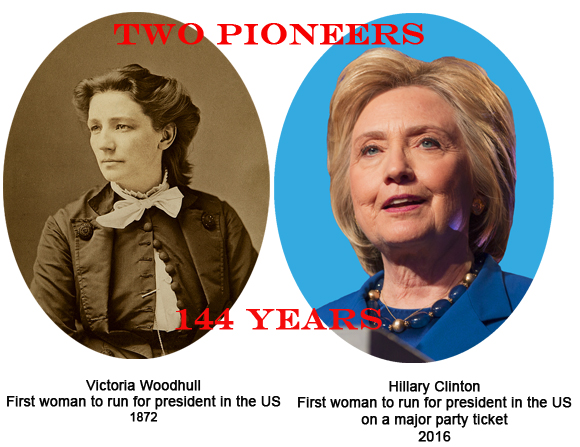
Victoria and Hillary

When we think of women in politics, their inclusion in places of power seems to be a recent occurrence, but women have been raising their voices since the 1840s in support of women’s suffrage. For some, this led to running for office even before their fellow women could vote for them. In 1870, less than a decade after the Civil War ended and 50 years before women would be granted the right to vote, Victoria Woodhull announced she was running for president in the 1872 election, a move never before attempted by a female in the United States. In 2016, we have our first female running for president on a major party ticket in Hillary Clinton. Let’s take a look at what’s changed and what hasn’t in those 146 years.

1872: Women didn’t mettle in business or political affairs. It was unthinkable for a woman to vote, much less run for office. As anti-suffragist Catharine Beecher once wrote, “the Holy Scripture indicates for women a sphere higher than and apart from that of public life because as women they find a full measure of duties, care and responsibilities and are unwilling to bear additional burdens unsuited to their physical organization.”

Victoria Woodhull set out to prove this mindset was flawed. She and her sister Tennie opened the first stock brokerage on Wall Street owned and operated by women and were successful at it. Women weren’t allowed at the New York Stock Exchange, but Victoria found a way around that, relaying her business transactions through men, and making millions of dollars.

2016: Women are regularly leaders in companies and are elected to office, but not on par with men. We have a long way to go before we see equal representation. While 46.8% of the total labor force in the United States is female and women hold 51.5% of management and professional positions, women currently hold only 4% of CEO positions at S&P 500 companies and only 19.2% of all board seats at those companies. (See Catalyst.org for more.)

According to Rutgers University, “in 2015, 104 women held seats in the United States Congress, comprising 19.4% of the 535 members; 20 women (20%) served in the United States Senate, and 84 women (19.3%) served in the United States House of Representatives. Four women delegates (3D, 1R) also represent American Samoa, the District of Columbia, Guam, and the Virgin Islands in the United States House of Representatives.” The Nation estimates that “at the current rate of progress, it will take nearly 500 years for women to reach fair representation in government.” More optimistic researchers have estimated “it will be 2121 before women reach gender parity in Congress…and [the estimate for when we’ll reach] pay equity is like 2058.”

***

1872: Women weren’t supposed to run for office. In the nineteenth century it was not even considered proper for a woman to speak in public because it was believed by doing so, she drew shame upon her father/husband, much less run for elected office.

That didn’t stop suffragists like Susan B. Anthony and Elizabeth Cady Stanton. Victoria Woodhull joined them in speaking out for that right, but she also vehemently supported workers’ rights, the humane treatment of prostitutes, and the rights of women to not be sexually subservient to their husbands within marriage. From 1871 on, Victoria was a regular fixture on the lecture circuit along with famous women like Anna Dickinson, traveling around the country to speak her controversial ideas. Victoria took the idea one step further by running for the highest one in the land in 1872. That same year, her sister Tennie ran for Congress as part of a small district in New York. Neither woman won, but they set a precedent thousands later followed.

2016: Women can run for office, but are still discriminated against. In the 21st century, the “woman card” shouldn’t even exist – all candidates for office should be evaluated by voters (and other candidates) based on their experience, platform and positions. Yet, as Mr. Trump’s now-famous quote shows, women are treated differently when they run, though not in the way he seems to have implied with his statement. The media are more likely to talk about a female candidates’ appearance, specifically her hair and clothing, than a man’s (the exception may be Mr. Trump’s hair.) While some argue that bias is all in our heads, nearly three in four of the women interviewed as part of a report recently released by Political Parity said they had felt discriminated against in politics. (See also Men Rule: The Continued Under-Representation of Women in US Politics for additional reasons why women may feel discriminated against.)

According the Political Parity report, women often lack funding and support from their political parties. “Two-thirds of women say it is difficult to raise the money needed to run effectively and nine in ten women saying fundraising influences their decision to try for a national or statewide seat.” They have the confidence and ability to ask for it, but having the network to ask is a roadblock. Could this be the remnants of the “old boys club” in politics? While the report doesn’t say, it stands to reason.

***

1872: Women did not have the right to vote. Even though women had been campaigning for suffrage since the Seneca Falls convention in 1848 and the Nineteenth Amendment was introduced in Congress in 1878, it wasn’t ratified until August 18, 1920. Even then, it took 12 states (not counting Alaska and Hawaii) anywhere from another month to 64 years to ratify it. (Mississippi was last, finally ratifying the Nineteenth Amendment on March 22, 1984). In some Southern states, African American women were harassed, attacked and in other ways prevented from voting into the 1960s. On August 6, 1965, The Voting Rights Act was signed into law, finally allowing all women, regardless of race, to vote as full citizens.

2016: Women have the right to vote. Victory! According to VoteRunLead, 53% of voters in the 2012 election were women.

***

1872: The media attacks female candidates by calling them names and digging into their personal lives. Newspapers analyzed every move political candidates made, including, in the case of Victoria and Tennie, their clothing, bearing, family lineage and suitability as public figures. Just as today, the candidates attacked one another in the papers and were in turn attacked by them. When Victoria’s mother, Anne, sued Victoria’s husband in 1871, the newspapers lapped up every dirty secret that came out in court, often blowing them out of proportion. In 1872, Harper’s Weekly published a cartoon dubbing Victoria as “Mrs. Satan” because she urged women to fight back against sexual slavery and mistreatment within marriage.

2016: The attacks have moved to TV and the internet. Since the 1990s, we’ve watched the media dig into Hillary Clinton’s personal life, even going so far as to attack the then-teenaged Chelsea Clinton, which prompted Hillary to ask the press not to cover her daughter. Of course, throughout her husband’s sex scandals, Mrs. Clinton’s every move and word was chronicled and her motivations and thoughts speculated on in both mainstream media and tabloids. In this most recent campaign, Donald Trump has dubbed Hillary as “Heartless Hillary” and “Crooked Hillary,” because she came out in favor of gun control and because she was attacking him in ads.

This is a long way of showing that while women made some great strides in some areas of politics and society, in others, the more things have changed, the more they have stayed the same. Perhaps that will change over time naturally as more women run for office and attain power. Perhaps if Hillary Clinton wins the November election and becomes our nation’s first female presidential candidate, it will happen more rapidly. But as a female, I find it sad that our advances haven’t been greater in a century and a half. But then again, that gives my generation something else to fight for. Maybe someday our daughters and nieces will be asking us why such issues ever existed.

What are your thoughts? How do you see things having changed or not changed? What change do think is most pressing?