Book Review: A Discovery of Witches by Deborah Harkness

It’s rare to find a book that you think about even when you’re not reading it and whose world you’re more involved in than your own. But that’s how it was for me with Deborah Harkness‘ A Discovery of Witches – a book that’s pure magic to me (no pun intended). It’s now in a three-way tie for my all time favorite book (with Jennifer Lee Carrell’s Interred with Their Bones and Anne Fortier’s Juliet, in case you were wondering). The very fact that I wanted to read it again right away and was actually sad to have to return it to the library says a lot.

The story centers on Diana Bishop, a 30-something historian who specializes in  Medieval alchemy. When researching at Oxford, she accidentally calls up a long-lost, spellbound manuscript, Ashmole 782. She senses something strange about it and opens it, but doesn’t read it. Although she’s descendant from a long line of witches, she wasn’t trained to use magic and so doesn’t realize the impact of her ability to break the spell. She returns the manuscript just like any other book. That’s when a host of vampires, demons and other witches start following her every move, all desperate to unlock the mystery of Ashmole 782, even if it costs Diana her life. Along the way she discovers she does indeed have magical powers (something else those otherworldly creatures are interested in) and forges an unlikely bond with vampire Matthew Claremont, an alliance that will both threaten and change her life in ways she could never imagine.

I’ve seen this book described as “Twilight for the academic set.” That’s like comparing foie gras with a hot dog. Yes, they both have controlling vampires. That’s where the similarities begin and end, in my opinion. Twilight was a teenage love story with nothing more at stake (seriously, no pun intended) than Bella’s life and heartbreak. This book is about the interaction of witches, humans, vampires and demons (which could be seen as an analogy for racial tolerance), evolution and the future of all of their kinds. It’s about magic and mystery and their place in a scientifically dominated world. I’d say the stakes are a little higher here.

I had no idea there were vampires in this book when I picked it up.  It contains three of my very favorite things: ornate libraries, an old, mysterious book, and magic (the Wiccan kind, not the Harry Potter kind), so I was hooked immediately. Even if that doesn’t do it for you, the mystery surrounding the manuscript of Ashmole 782 will.

I’m a huge fan of character-driven fiction and a Discovery of Witches excels in character development. You learn so much about them from their day-to-day lives and interactions with each other. Some are likeable, others are not, and there are a few you don’t know if you can trust. Diana is by far my favorite, but then again, I relate to her on a number of levels, including her love of history, old books and unfortunate propensity toward panic attacks. For some odd reason, I was captivated by Diana’s hobby of rowing (sculling to be precise) and plan to take that up myself as a result of having read this book. Matthew, despite being the main love interest, doesn’t make me fall in love with him. I like him as a character, but I think it’s my inability to trust him that keeps me at a distance. My favorite character is Marthe. Somehow, her mix of humor and down-to-earth wisdom is the perfect foil to Diana, Matthew and Ysabeau, all of whom can be too serious.

The world, writing and plot of this book are also handled with expertise. I’ve never been to any of the locations, nor had I ever seen sculling before, but thanks to Harkness’ evocative descriptions, I could see and hear it all. And all of the meals and wine that were described kept me hungry and in need of a drink (in a good way)! I especially love the Bishop House, which really is a character unto itself. It gave the book some much-needed levity.

A Discovery of Witches seems to be a love it or hate it book, judging from the number of one- and five-star reviews on Goodreads. It’s a very layered story, and if you only take the time to focus on one point, you’re going to miss a lot. This is a book that should be savored. But that doesn’t mean it’s not without its flaws. There were some plot points I didn’t believe and others that I felt deserved more explanation, but I’m trusting Harkness has her reasons for handling things the way she did. That’s one of the problems with not being able to read a series all the way through. A lot of times the author does things a certain way that will make perfect sense once you can see the story as a whole as she does. But as readers, we don’t have that option along the way (at least not until all the books come out).

(This is the short version of my review. If you want to read my long, spoilery, very passionate review, you can find it here on Goodreads – but I would suggest reading the book first because I touch on almost all the major plot points.)

At the time of this writing, I’m about half way into second book and enjoying it immensely as well. Stay tuned for a possible review of that book in the future.

PS – If you get the chance to listen to the audio book, Jennifer Ikeda does an incredible job as the narrator.

Have you read A Discovery of Witches? Did you like it? Why or why not? What kinds of books interest you?

X is for Xenophon, the Original “Horse Whisperer”

Xenophon was a Greek historian, philosopher and solider from Athens. He’s well-known for his historical works, but I’m interested in him for his thoughts on horses because riding/grooming/training them would have been second nature for Guinevere and Arthur. He wrote two equine-related works, The Calvary General and On Horsemanship. The later was written somewhere around the year 350 BC, making it one of the earliest works on horsemanship in the Western world that still exists today.

In On Horsemanship, Xenophon displays a philosophy far ahead of his time, advocating over and over for the kind treatment of horses in a time when beating and whipping were the most common methods. “The golden rule in dealing with a horse is never approach him angrily…When a horse is shy of some object and refuses to approach it, you must teach him that there is nothing to be alarmed at…or, failing that, touch the formidable object to yourself and then gently lead the horse up to it. The opposite plan of forcing the creature by blows only intensifies its fear, the horse mentally associating the pain he suffers at such a moment with the object of suspicion” (28).

He also emphasizes the importance of the relationship between horse and master. “It is best that the stable be placed in a quarter of the establishment where the master will see the horse as often as possible” (20). And again, “If you would have a horse learn to perform his duty, your best plan will be, whenever he does as you wish, to show him some kindness in return, and when he is disobedient, to chastise him” (39).  He emphatically states, “Far the best method of instruction is to let the horse feel that whatever he does in obedience to the rider’s wishes will be followed by some rest and relaxation” (50).

Other topics include:

  • A head to hoof analysis on how to select a young horse, many of which are still applied today.
  • How to properly break a colt, with the goal that the horse will grow to love people, rather than fear them.
  • How to avoid being cheated when buying an older horse.
  • Caring for a horse, including proper stabling, feeding and attending to the horse.
  • Grooming the horse, with special emphasis on the duties of a groom.
  • Bridling the horse correctly and safely.
  • Mounting and training the horse.
  • Advanced training for the war horse, including jumping and cross-country riding.
  • Working with an overly spirited or dull horse.
  • Working with a horse for the purpose of show.
  • Using horses in parade.
  • Equipment for battle, including how to arm a horse and rider, how to mount a horse with a javelin (very popular in the Celtic world) and how to properly wield weapons while on a horse.

I found out about this wonderful book because another author who has told Guinevere’s story, Nancy McKenzie, cited it as one of her references. I’m so glad she did. It’s a great basic instruction for the novice, though more detailed questions are probably better answered by an expert or experience. But considering I’ve yet to ride a horse, I think it’s a good place to start!

Have you ever heard of Xenophon? Are there any equine books you’d recommend, especially as historical resources? If you know horses, what do you think of his ideas?

K is for Kushiel’s Dart

Forget 50 Shades of Gray. (No, I haven’t read it.) If you want novel that is well written, meticulously plotted and epic in scope, that will also get your blood pumping, read Kushiel’s Dart by Jacqueline Carey. I don’t think it’s meant as erotica, and it’s certainly much more than that, but some choose to classify it that way. And that’s shame because they’re missing the bigger picture.
I had no idea what I was getting into when I read this book about six months ago, but it is amazing. I can’t begin to say how much I loved it. If you can get beyond the non-traditional sex scenes (you may not want to try these at home) in the early part of the book (they have mythological and plot purposes in the story, so they’re not gratuitous), you’re in for an amazing ride that will have you questioning who you should be rooting for until the very end.

Jacqueline Carey packs more intrigue and action into this book than most authors would have attempted in a series of three or four books. As such, keeping the players and the politics straight is difficult (people and places have foreign-sounding names that can be challenging to remember) but as long as you remember a few key characters, you’ll be fine. But the more you pick up, the richer the plot will be for you.

As an alternative history, it’s very interesting to see echoes of ancient Rome, the Picts, Irish, Anglo Saxons and others in the geography, history and characters. There are even a few who seemed to me to be veiled versions of mythological heroes such as King Arthur, Tristan and Fionn mac Cumhaill, to name a few. This is not to say Carey lacks in original characterization. On the contrary, she takes these archetypes and raises them to a whole new level, while making you truly care (and perhaps be smitten by) many of her original characters.

The writing and plotting of this book is superb. Everything happens for a specific reason (as it should in all books, but doesn’t always) and the connections between events is eventually made clear. Carey has a skill for descriptions and world building that makes you never want to leave. I could feel every movement of the journey and I’ll admit to spending a few hours reading when I would have been sleeping. As a writer, I appreciate the work it must have taken to create such an outstanding book. I feel like I will be a better writer in the future just for having read her writing.

If I had one criticism of the book, it would be that the ending left me wanting, which is natural for the first book in a series, but after all I went through with these characters I wanted more resolution. Carey was heading there, but then changed course and I can’t say I completely believed two of the character’s motivations in how the setup for the second book was accomplished. But, this book is so well-written that I may just have to sign up for the next installment.

Have you read Kushiel’s Dart? What did you think of it? Do you have any ideas for future “K” topics?

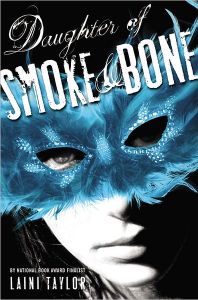
D is for Daughter of Smoke and Bone

“Once upon a time, an angel and a devil fell in love. It did not end well.”

Great opening line, right? So begins Daughter of Smoke and Bone by Laini Taylor. If I had a daughter, I’d be proud to have her read it. This Young Adult (YA) urban fantasy is witty, intelligent and captivating. And unlike some other YA books, it manages to get morality across without being preachy.

Daughter of Smoke and Bone is the story of Karou, a 17-year-old girl in Prague who is by day an art student and by night an errand runner for Brimstone, a strange creature part of a race called Chimera. He trades teeth (animal and human) for coins that grant wishes on the supernatural black market. Karou doesn’t know her parents, her past or how she got mysterious eye-like tattoos (called hamsa) on the palms of both of her hands. Brimstone raised her from a baby and as a result, she is aware of how the supernatural world overlaps our own. Eventually, her two worlds collide when menacing black handprints are seared into the doors that are portals between the worlds, and a mysterious angel named Akiva becomes obsessed with her, leading her on a voyage of self-discovery that will change her life, her very identity, and set the stage for an Otherworldly war.

Hamsa

Though this book is fantasy, the thing I liked most about it was how much I could relate to it. Karou and her best friend, Zusana, remind me of me and my best friend (even down to the eerily accurate conversations) and Karou is very normal, despite her knowledge of supernatural things. She makes mistakes and suffers the same trials and temptations of every teenage girl. Even Brimstone, as animal as he is, is the father/brother/protector every girl/woman should have in her life at least once. In the mist of all the wishes, magic and impossible feats is a very real love story and a chilling tale of hate and genocide that smacks very much of our own history.

And if that wasn’t enough, Laini Taylor writes in such an evocative way, you feel like you’re walking through the streets of Prague with her. Her writing is lyrical and beautifully done.

Did I mention these books are laugh out loud funny? I listened to them on audiobook, and it’s a good thing I was alone, because I snorted a few times. One of my favorite exchanges comes near the beginning of the book:

“’I don’t know many rules to live by,’ he’d said.  ‘But here’s one. It’s simple. Don’t put anything unnecessary into yourself. No poisons or chemicals, no fumes or smoke or alcohol, no sharp objects, no inessential needles–drug or tattoo–and…no inessential penises either.’

‘Inessential penises?’ Karou had repeated, delighted with the phrase in spite of her grief. ‘Is there any such thing as an essential one?’

‘When an essential one comes along, you’ll know,’ he’d replied.” 

I picked up Daughter of Smoke and Bone not because of all the acclaim around it (it’s been on practically every #1 list out there), but because author Veronica Roth recommended it on the basis of the quality of the writing. I’m so glad I took her word for it. I hope you will love it as much as I did. I can’t wait for the second book in the series, which is due out this fall.

Have you read Daughter of Smoke and Bone? What did you think of it? What other D topics would you like to read about? 

Book Review: King Arthur’s Children

I met the author of King Arthur’s Children: A Study in Fiction and Tradition, Tyler R. Tichelaar, Ph.D., while searching online for other Arthurian enthusiasts. When he asked me if I would review his new book, I jumped at the chance.

The book’s title would certainly make me pick it up off a shelf, but it doesn’t do the work justice. This interesting, impeccably researched book profiles several possible sons of Arthur, but also discusses the circumstances in various traditions influencing the actions of Guinevere, Lancelot and Constantine, as well as possible reasons for and outcomes of the battle of Camlann. Interesting twists to the legends explained in this book include:

  • Lancelot and Mordred may have been twins.
  • In some traditions, King Arthur, like the Biblical King Herod, has all the children born around the same time as Mordred drowned.
  • Mordred was not always evil; he was revered in Welsh and some Scottish tales.
  • Guinevere took many other lovers besides Lancelot, including several Knights of the Round, depending on the source.
  • The battle of Camlann may have been written as a tragedy to make the legends more interesting and memorable.
  • Mordred may have lived after Camlann or had sons who did.

King Arthur’s Children is broken up into three sections. The first discusses three possible sons of Arthur in various stories that make up the Welsh collection known as The Mabinogion. These are the likely illegitimate Gwydre; Amr, the child of Arthur’s first wife or mistress/concubine; and Llacheu, who is also mentioned the 10th century poem “Black Book of Carmarthen.” Tichelaar posits that if a historical King Arthur ever existed and had sons, these three are the most likely and were probably later combined to turn history into legend.

Part two of the book is devoted to Arthur’s most famous son, Mordred, who actually  first appeared in Arthurian legend without reference to his relationship to Arthur and then as Arthur’s nephew. Only later did he become the son spawned by incest we know today. (Tichelaar’s section on incest in the legends is uncomfortable to read, but clearly illustrates the reasons why it was once a less taboo subject.) Tichelaar does a remarkable job of showing the dizzying number of ways in which Mordred may have been influenced by or have influenced his Welsh counterparts from part 1. This is also the section where he goes into other Arthurian characters and how they may or may not have been related to Mordred. He then studies the honorable Mordred in Welsh legend, his vacillating virtue among the Scots, and the more sympathetic treatment given him by modern writers.

The conclusion to this section is the one weak spot in the book. Here, Tichelaar’s fascination with genealogy draws him away from his main subject into two chapters on how the English Royal Family and the Scottish clan Campbell both have tried to claim succession from King Arthur. I can see why Tichelaar included this – because by claiming to be descendants, these groups could arguably be King Arthur’s children – but I feel like the discussion of their forced (and possibly faked) lineage distracts from the overall point and flow of the book. However, if you’re a genealogy buff, you’ll probably like this section.

The final part of the book details how King Arthur’s children were handled by medieval, Renaissance and modern writers. Here, Tichelaar does a great job of summarizing works most people probably haven’t read or even had access to, and explaining how each successive generation of writers has added to the legend. Interestingly, he points out that the most recent writers are more likely to invent new children, especially daughters. He also gives a small preview of his own forthcoming work of fiction, King Arthur’s Legacy.

All in all, I really enjoyed this book and am proud to be able to include it on my list of resources for my contribution to the legends. King Arthur’s Children is of great value mainly because it expertly explores an area of Arthurian legend that has not (at least to my knowledge) been widely researched before. I would recommend it to anyone who already has solid knowledge of Arthurian legend. To get the most out of it you need a fairly strong background in the legends and at least a cursory knowledge of Welsh legend. My studies of Welsh legend are rudimentary, so some of his comparisons between these and Arthurian legends went over my head. But I’m sure others will be able to better appreciate them.

While Tichelaar plays with (and yearns for) the idea that King Arthur’s bloodline may still exist today, he makes one of his most moving points in reference to the always changing nature of the legends, stating: “Anyone who would be a descendant of King Arthur need not have a fifteen hundred-year-old pedigree to prove it; we need to tell the tales about Arthur, and when people hear these stories, he will then live on in their hearts and his line and descendants will continue to grow” (vi). I, for one, am proud to call myself a daughter of King Arthur in that capacity.

My Top 10 Favorite Fiction Books

Thought I’d give you all a break from the educational posts for a few weeks. One of my Twitter friends (@JuliaL2445 you might want to follow her – she’s cool) has been asking me to do a top 10 favorite (fiction) book list for a while now, so here it is. This was a lot harder than I expected because my list keeps changing. (BTW – If you’re on Goodreads please friend me there. If not, check it out. It’s the site for book lovers.)

Instead of giving you a plot summary, I’m going to tell you why each book is on my favorite list. If you want to know more about the book, click on the title to go to its Amazon.com page or on the author’s name to go to his/her website.

1. – tie) Interred with Their Bones by Jennifer Lee Carrell – Modern-day thriller meets Shakespeare. This is the only book I’ve ever read with the perfect balance of page-turning plot, characterization, description and smart dialogue. And you don’t have to know much about Shakespeare to understand it. Oh and one of the characters supplanted Edward Cullen as my fictional boyfriend. 😉 The sequel, Haunt Me Still, is amazing as well. But read this one first.

1. – tie) Juliet by Anne Fortier – A thriller with a dash of romance and yes, more Shakespeare. This is the most romantic (not graphic) book I’ve ever read. Amazing characters, fast paced plot and breathtaking descriptions that make you feel like you’re in Sienna.

3.) Moll Flanders by Daniel Defoe – There’s only one word to describe this classic: delicious. Scandalous when it was written in the early 1700s, it may make you blush even now. This book has it all: wealth, thievery, poverty, scoundrels, romance, adultery, incest, hangings, etc. The version I read had no chapter breaks, but if you keep with it, you’ll thank me. And if you want a head start, watch the BBC miniseries first. But then read the book because there’s so much more to the story.

4.) Caleb’s Crossing by Gerlandine Brooks – This is what all historical fiction should aim to be. So true to the early American colonies I feel like I’ve traveled back in time. And the author has accomplished the strongest characterization I’ve ever seen. No wonder she’s a Pulitzer Prize winner (for another book). I’m currently reading this and it’s already cemented its place in my top 10.

5. – tie) The Hunger Games by Suzanne Collins – Ever since reading 1984 in high school, I’ve been fascinated with dystopian worlds. This one takes it to a whole new level. The privation faced by the characters made me truly grateful for what I have and changed my outlook on life. The story itself is riveting, but it was the emotional connection I formed with the characters while reading that put this on the top of my list.

5. – tie) Divergent by Veronica Roth – I couldn’t put this book down. It’s similar to The Hunger Games in many ways, but also very different. The idea of the factions and trying to figure out which one I’d be in or which one my parents would have raised me in or how/if I’d survive in her world kept me intrigued. And it takes place in Chicago, so of course I love it.

7.) City of Bones by Cassandra Clare – I’m not one for urban fantasy, but hello literary perfection. Cassandra’s descriptions are the best in the biz, her plots are meticulously…well, plotted, and this book introduces one of the most charming characters to grace a page in years. It’s approachable fantasy – more like an alternate world we mere mortals cannot see than a wholly different one. I also recommend the other books in this series, especially #3, City of Glass.

8.) Mage Heart by Jane Routley – This is the first high fantasy book I ever read and it was something like 13 years ago, but I adore this book. It’s funny and poignant all in turns and is a gentle introduction into the world of high fantasy. I also recommend the sequel, Fire Angels, for its rich landscape, romance and enthralling magic.

9.) The Thirteenth Tale by Diane Setterfield – Mix poetic language so vivid you want it to soak in through your skin with just enough gothic horror to make your hairs stand on end and you have this book. It kept me guessing from the first page to the last.

10.) The Mists of Avalon by Marion Zimmer Bradley – This book changed my life in many ways. It was the first place I ever read about Avalon and strongly shaped my views of the sacred isle. (You’ll see similarities in my book, but I also did my own research and formed my own vision, but this was the start.) And without her portrayal of Guinevere (which I hated), I never would have thought to write my own version. It’s a fabulous book with very strong female characters – the first in a great tradition I’m proud to carry on.

Now it’s your turn. Please share your favorite books, and maybe even why they’re so special to you, in the comments.

Five Summer Book Picks

So in case you’re tired of hearing about my writing (and don’t tell me if you are!) here are my top five book picks for summer, some of which I’ve read and some that are on my list:

  1. Divergent by Veronica Roth – I. Couldn’t. Put. This. Book. Down. Seriously. Just finished it last night and I’m already wondering what the next one’s going to be like. The best way I can describe it is The Hunger Games meets Nikita (current TV version). Set in a dystopian, post-apocalyptic version of Chicago, teenagers must choose in which of five virtue-based factions they’ll live the rest of their lives, and of course action and romance ensue.
  2. Juliet by Anne Fortier – No time for a summer vacation? Read this thriller and you’ll feel like you’re in Sienna, Italy. (In fact, I’m planning a trip there next year just because of this book.) Juliet and her sister Janice have just lost their dear Aunt Rose when Juliet finds out the family has been hiding a secret that may mean she’s related to the person on whom Shakespeare based his famous character of the same name. Juliet travels to Italy and uncovers the original story of Guiletta and Romeo (the one before Shakespeare’s version and, yes, there were ones before him) all the while unraveling her own family mystery. This is one of the most romantic (not graphic or raunchy) books I’ve ever read – tied for my all-time favorite book.
  3. The Rossetti Letter by Christi Phillips – Siena not your style? How about Venice? In this historical thriller a single letter unites a modern-day historian to a 17thcentury Venetian courtesan and murderous plot to overthrow the city. And the plot is based on a real conspiracy. The writing so rich you’ll be able to hear the waters lapping at the canal banks, guaranteed.
  4. Abandon by Meg Cabot – I just started this book because the author is coming to town and I won’t go to a signing not having read the author’s work. And I wanted to read it anyway. It’s a modern retelling of the Greek myth of Persephone and Demeter. Slow to start so far, but given that it comes from the author of the Princess Diaries, I’m hoping it won’t disappoint.
  5. Shiver by Maggie Stiefvater – This one’s been big with the YA (Young Adult) crowd for a while now and the author is also coming to town, so I bought it. It’s next on my list. All I know is it is about werewolves (and I hate werewolves), but a friend of mine shared a few passages and the writing is lusciously lyrical. Here’s part of what Amazon.com said about it: “Told from alternating points of view, the narrative takes a classic Romeo & Juliet plot and transforms it into a paranormal romance that is beautiful and moving… A must-have that will give Bella and Edward a run for their money.”

What about you? What are your summer book picks? Or even your favorite books? Tell me in the comments below. We may have some favorites in common.