Reenacting the Election of 1872 (pictures included)

As close to meeting Victoria Woodhull as I will ever get!

As close to meeting Victoria Woodhull as I will ever get!

As some of you know, last weekend I had a the great privilege of participating in a re-enactment of the election of 1872 (the one Victoria Woodhull ran in) at the Ulysses S. Grant National Historic Site in south St. Louis County. I’ve never done re-enactment before (I’ve been to Renfaires, but only as a spectator), so this was a totally new experience for me. I was stationed at table with a few other women under the banner “Votes for Women.” We stayed in character some of the time as campaigners for Victoria, but the rest of the time was spent answering questions about her and about my book. I even got to do an impromptu Q&A session after Victoria gave her speech on Sunday.

Much to our surprise, Rebecca Rau and her camera man showed up to film part of their documentary about Victoria, The Coming Woman, at the event. Rebecca and I have become friends on Twitter and Facebook and she saw me post about it, hopped on a plane and there she was! I think she got a lot of good footage from the actors playing Victoria, Horace Greeley, Frederick Douglass, Virginia Minor and others. I particularly enjoyed Frederick Douglass – he’s a man I need to learn more about – and Virginia Minor, whose speech was so moving. And of course, they recorded the rest of us. She even interviewed me on-camera, so you may be seeing me in the film!

The park estimates we had 750-800 people come through. Yes, I may have sold some books by talking with people and handing out postcards (I wasn’t allowed to sell on-site), but more important than that is that this was a huge opportunity for me to get Victoria’s name out there and educate people about her. Only a handful of those we talked to had ever heard about her. Spreading the word about this amazing woman is the whole reason why I wrote my book in the first place, so through this event, I know I achieved my goal of helping get her name in the historical record where it belongs!

Oh, and we held a mock election. The men at the booth harassed us females good-naturedly for trying to vote (remember, this was 1872 and women didn’t get the right to vote in the US until August 1920). Although it was all in good fun, it gave me a small sense of what it must have been like for the women like Victoria, Tennie, and Susan B. Anthony who really did try to vote and were turned away due to their sex, and in Susan’s case, even arrested. In the end, Victoria came in second to Grant, beating Greeley by a long shot. While I would have LOVED to have seen her elected, I realize now that wasn’t likely when the event was being held on the grounds of Grant’s former home.

Speaking of, I also got to tour the grounds, which include Grant’s home of White Haven, a barn, a chicken house and several other buildings used by slaves and animals. As a history lover and life-long St. Louisan, I’m ashamed to admit I didn’t know that this place existed until about a month ago. It was very interesting to see that such amazing history is right in my own back yard. I’ve been to nearby places like historic St. Charles, old town Florissant, downtown St. Louis and even Cahokia Mounds across the river in Illinois, but this place really struck a chord with me. Maybe it was because I could tie it to a specific small group of people and that made it more personal; maybe I’m just more aware now that I’m older and more educated through my research. Who knows. But I was fascinated by some of the stories told by the staff and on plaques in the houses. There may be a future novel there. But I need to get the other 20 or so written first!

If you want another perspective on the day, here’s a post written by one of the other participants. The comments are interesting as well.

And now, on to pictures, which is what you are really here for, right?

Grant's home, White Haven

Grant’s home, White Haven

Suffragists!

Suffragists!


Frederick Douglass

Frederick Douglass

Horace Greeley

Horace Greeley

Frederick Dent (right) and a reporter

Frederick Dent (right) and a reporter

Virginia Minor

Virginia Minor

Camelot’s Queen is an Indie B.R.A.G. Medallion Winner!

registered-800Holy crap, y’all! Camelot’s Queen was just awarded the Indie B.R.A.G. Medallion! That means it is designated as one of the best indie books on the market. Not only is this Camelot’s Queen‘s first award, it’s one that even Daughter of Destiny, which has won a ton of awards, did not achieve.

It should be listed on the Indie B.R.A.G. site shortly and they will be doing a series of promotions for it.

And if I can tell you a little secret, I like Camelot’s Queen even better than Daughter of Destiny.

I owe you several more blog posts, especially about the re-enactment of the election of 1872 and my trip to Oxford, among other things rattling around in my head. I will have them for you soon.

Join Me in Campaigning for Victoria Woodhull – A Reenactment of the Election of 1872

grant-and-greeley-final_1This weekend if you’re in St. Louis and looking for something to do, I encourage you to attend a free unique event: a reenactment of the election of 1872, in which Victoria Woodhull ran for President. The event takes place September 9-11 at the Ulysses S. Grant National Historic Site in south St. Louis County. Here’s the website with all the details.

I will be there in period clothing “campaigning” for Victoria from noon – 7:30 p.m. on Saturday and noon to 4:30 p.m. on Sunday. The event includes a mock election, so make sure to cast your vote for Victoria! It would be really cool if we could get her to win 144 years later! Victoria will be speaking several times throughout the day, as will the other candidates.

And yes, I will post a few pictures after the event, for those who can’t make it.

I wish I could explain how important this event is to me. I fell in love with Victoria through my research and so short of time travel, this is as close to doing her justice as I will ever get. I’m looking forward to sharing the knowledge I gained from my research and hopefully getting her into office, even if only symbolically. I hope you can join me for this once-in-a-lifetime opportunity to live history!

More Awards!

Hello from Oxford, England! I’m having a blast (at least one post and pictures to come when I get back)!

I’m proud to announce that Daughter of Destiny has won the Gold Medal in the General Fantasy category of the Readers’ Favorite Book Awards! Been Searching for You was a finalist in the Chick Lit category. Camelot’s Queen didn’t place in the finals, but did recieve a 5-star review, as did the other two books.

I’ll enter Madame Presidentess in the 2017 awards.

Two More Awards and A Sequel Announcement!

DoD CIPA EVVYI’m so happy to announce that Daughter of Destiny (fairy tale/folklore) and Been Searching for You (romance) both placed first in their categories at the Colorado Independent Publishers Association (CIPA) EVVY Awards this weekend! Here’s the full list of winners. (They are the only two books I entered. I’ll enter the other two next year.)

And…

BSFY CIPA EVVYBeen Searching for You was meant to be a standalone book, but so many of you have asked for a sequel that I started to think about it and I’m proud to say, there will be not one more book in the series, but at least two more. I’m actually thinking this *could* end up being an open-ended series. I have an idea for a fourth book percolating. But I have to write the second one first.

The second book doesn’t have a title, but I can tell that the main character is Miles’ long ago ex, Violetta. (She’s mentioned very briefly in Been Searching for You. Blink and you may have missed it.) I don’t know all the details yet, but I promise you our favorite BFF gets his happily ever after AND you get to see Alex and Annabeth’s wedding. I’m hoping to write it at some point in 2017. Not sure on a publication date. I’m still hoping Guinevere will start talking soon so I can write Mistress of Legend next.

Help me name this new series! I was originally thinking Love in the Windy City, but I’m not sure if I want to tie myself down to a location. Book 2 will take place both in Chicago and LA, as will book 3. Do you have any series name suggestions? I’d love to be able to say that a fan helped name the series! Let me know your thoughts in the comments.

Women in Politics and American Society: A Tale of Two Firsts

You may have seen this article in The Huffington Post, but in case not and because I’m so proud of it, I had to republish it here.
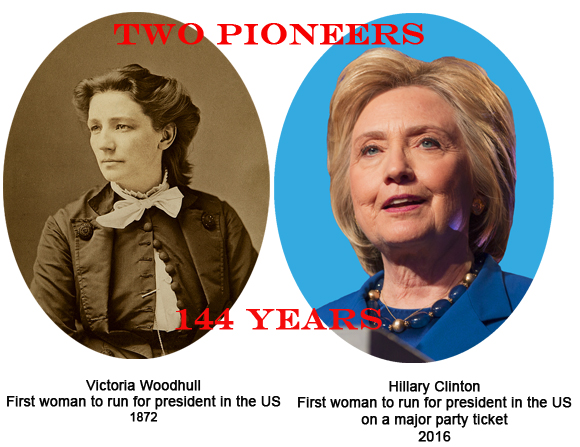
Victoria and Hillary

When we think of women in politics, their inclusion in places of power seems to be a recent occurrence, but women have been raising their voices since the 1840s in support of women’s suffrage. For some, this led to running for office even before their fellow women could vote for them. In 1870, less than a decade after the Civil War ended and 50 years before women would be granted the right to vote, Victoria Woodhull announced she was running for president in the 1872 election, a move never before attempted by a female in the United States. In 2016, we have our first female running for president on a major party ticket in Hillary Clinton. Let’s take a look at what’s changed and what hasn’t in those 146 years.

1872: Women didn’t mettle in business or political affairs. It was unthinkable for a woman to vote, much less run for office. As anti-suffragist Catharine Beecher once wrote, “the Holy Scripture indicates for women a sphere higher than and apart from that of public life because as women they find a full measure of duties, care and responsibilities and are unwilling to bear additional burdens unsuited to their physical organization.”

Victoria Woodhull set out to prove this mindset was flawed. She and her sister Tennie opened the first stock brokerage on Wall Street owned and operated by women and were successful at it. Women weren’t allowed at the New York Stock Exchange, but Victoria found a way around that, relaying her business transactions through men, and making millions of dollars.

2016: Women are regularly leaders in companies and are elected to office, but not on par with men. We have a long way to go before we see equal representation. While 46.8% of the total labor force in the United States is female and women hold 51.5% of management and professional positions, women currently hold only 4% of CEO positions at S&P 500 companies and only 19.2% of all board seats at those companies. (See Catalyst.org for more.)

According to Rutgers University, “in 2015, 104 women held seats in the United States Congress, comprising 19.4% of the 535 members; 20 women (20%) served in the United States Senate, and 84 women (19.3%) served in the United States House of Representatives. Four women delegates (3D, 1R) also represent American Samoa, the District of Columbia, Guam, and the Virgin Islands in the United States House of Representatives.” The Nation estimates that “at the current rate of progress, it will take nearly 500 years for women to reach fair representation in government.” More optimistic researchers have estimated “it will be 2121 before women reach gender parity in Congress…and [the estimate for when we’ll reach] pay equity is like 2058.”

***

1872: Women weren’t supposed to run for office. In the nineteenth century it was not even considered proper for a woman to speak in public because it was believed by doing so, she drew shame upon her father/husband, much less run for elected office.

That didn’t stop suffragists like Susan B. Anthony and Elizabeth Cady Stanton. Victoria Woodhull joined them in speaking out for that right, but she also vehemently supported workers’ rights, the humane treatment of prostitutes, and the rights of women to not be sexually subservient to their husbands within marriage. From 1871 on, Victoria was a regular fixture on the lecture circuit along with famous women like Anna Dickinson, traveling around the country to speak her controversial ideas. Victoria took the idea one step further by running for the highest one in the land in 1872. That same year, her sister Tennie ran for Congress as part of a small district in New York. Neither woman won, but they set a precedent thousands later followed.

2016: Women can run for office, but are still discriminated against. In the 21st century, the “woman card” shouldn’t even exist – all candidates for office should be evaluated by voters (and other candidates) based on their experience, platform and positions. Yet, as Mr. Trump’s now-famous quote shows, women are treated differently when they run, though not in the way he seems to have implied with his statement. The media are more likely to talk about a female candidates’ appearance, specifically her hair and clothing, than a man’s (the exception may be Mr. Trump’s hair.) While some argue that bias is all in our heads, nearly three in four of the women interviewed as part of a report recently released by Political Parity said they had felt discriminated against in politics. (See also Men Rule: The Continued Under-Representation of Women in US Politics for additional reasons why women may feel discriminated against.)

According the Political Parity report, women often lack funding and support from their political parties. “Two-thirds of women say it is difficult to raise the money needed to run effectively and nine in ten women saying fundraising influences their decision to try for a national or statewide seat.” They have the confidence and ability to ask for it, but having the network to ask is a roadblock. Could this be the remnants of the “old boys club” in politics? While the report doesn’t say, it stands to reason.

***

1872: Women did not have the right to vote. Even though women had been campaigning for suffrage since the Seneca Falls convention in 1848 and the Nineteenth Amendment was introduced in Congress in 1878, it wasn’t ratified until August 18, 1920. Even then, it took 12 states (not counting Alaska and Hawaii) anywhere from another month to 64 years to ratify it. (Mississippi was last, finally ratifying the Nineteenth Amendment on March 22, 1984). In some Southern states, African American women were harassed, attacked and in other ways prevented from voting into the 1960s. On August 6, 1965, The Voting Rights Act was signed into law, finally allowing all women, regardless of race, to vote as full citizens.

2016: Women have the right to vote. Victory! According to VoteRunLead, 53% of voters in the 2012 election were women.

***

1872: The media attacks female candidates by calling them names and digging into their personal lives. Newspapers analyzed every move political candidates made, including, in the case of Victoria and Tennie, their clothing, bearing, family lineage and suitability as public figures. Just as today, the candidates attacked one another in the papers and were in turn attacked by them. When Victoria’s mother, Anne, sued Victoria’s husband in 1871, the newspapers lapped up every dirty secret that came out in court, often blowing them out of proportion. In 1872, Harper’s Weekly published a cartoon dubbing Victoria as “Mrs. Satan” because she urged women to fight back against sexual slavery and mistreatment within marriage.

2016: The attacks have moved to TV and the internet. Since the 1990s, we’ve watched the media dig into Hillary Clinton’s personal life, even going so far as to attack the then-teenaged Chelsea Clinton, which prompted Hillary to ask the press not to cover her daughter. Of course, throughout her husband’s sex scandals, Mrs. Clinton’s every move and word was chronicled and her motivations and thoughts speculated on in both mainstream media and tabloids. In this most recent campaign, Donald Trump has dubbed Hillary as “Heartless Hillary” and “Crooked Hillary,” because she came out in favor of gun control and because she was attacking him in ads.

This is a long way of showing that while women made some great strides in some areas of politics and society, in others, the more things have changed, the more they have stayed the same. Perhaps that will change over time naturally as more women run for office and attain power. Perhaps if Hillary Clinton wins the November election and becomes our nation’s first female presidential candidate, it will happen more rapidly. But as a female, I find it sad that our advances haven’t been greater in a century and a half. But then again, that gives my generation something else to fight for. Maybe someday our daughters and nieces will be asking us why such issues ever existed.

What are your thoughts? How do you see things having changed or not changed? What change do think is most pressing? 
Cover Contest: Your Vote Needed!

The beautiful cover of Camelot’s Queen created by Jenny Q. is in this week’s Creme de la Cover contest over at InD’tale Magazine. If you could spare a moment to vote, I’d appreciate it. The winner gets a 1/4 page ad, and if we win the monthly contest, I’d get a full-page ad.

Thanks for your help!

More Awards for Daughter of Destiny and Been Searching for You

cipa-evvy-awards-2016-badgeI just found out that both Daughter of Destiny and Been Searching for You are finalists in Colorado Independent Publisher’s Association (CIPA) EVVY Awards Book Competition. Daughter of Destiny is in the Fairytale/Folklore category and Been Searching for You is in romance. Final placement will be announced August 20. More info then!

A Woman of History Who’s Time Has Come

So many creative projects are being made about Victoria Woodhull right now. Coincidence? I think not.